Defining Leadership Principles & Competency Models
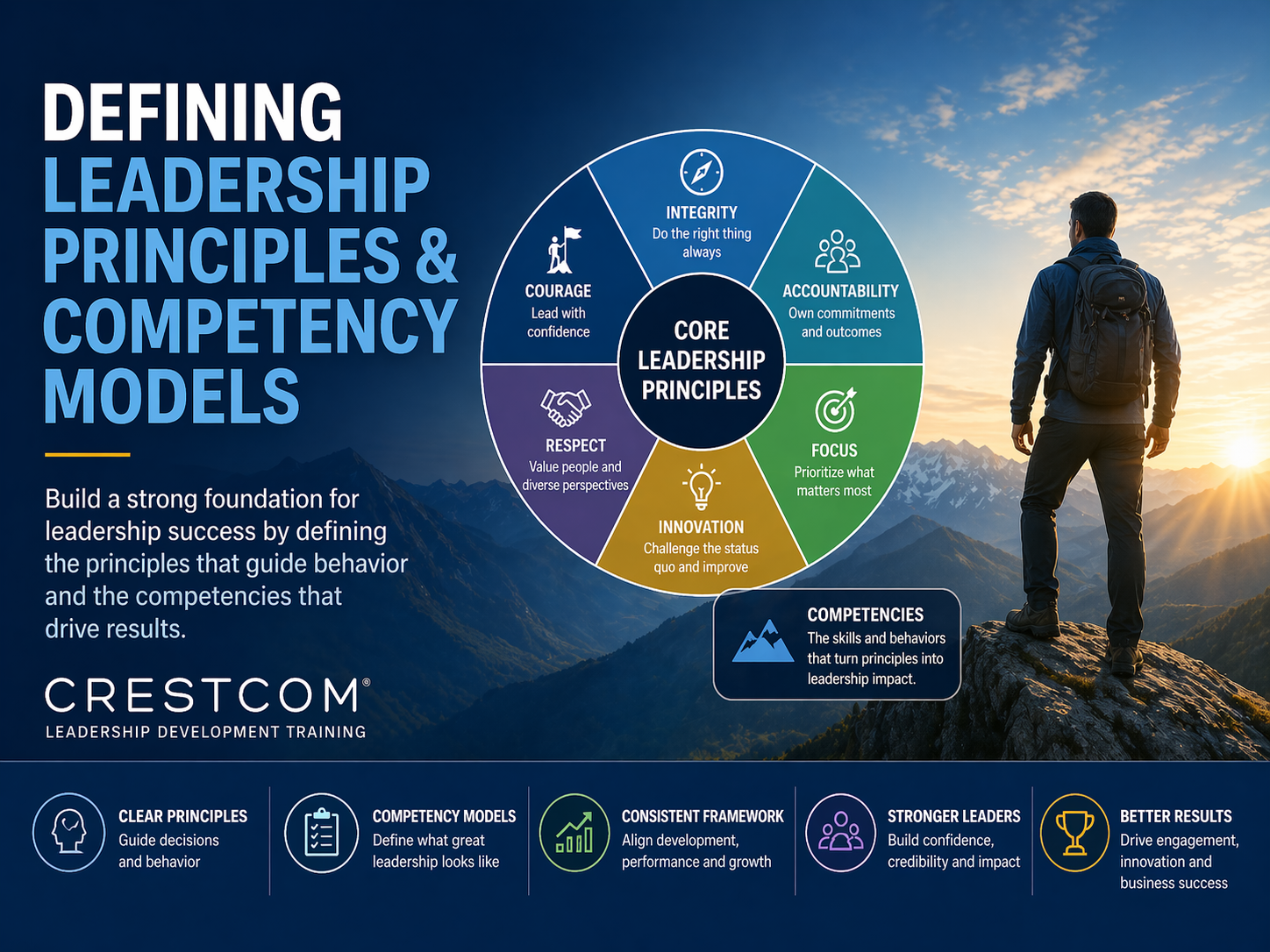
Many organizations invest heavily in leadership training yet struggle to see consistent, measurable results. The reason is often simple: leadership development efforts lack a clear foundation.
Without defined leadership principles and competency models, leadership training becomes fragmented, subjective, and disconnected from business outcomes. A well-designed leadership competency framework provides the structure needed to align leadership behaviour with organizational strategy, culture, and performance expectations.
In this guide, we explore why leadership competency frameworks matter, how to build models aligned with strategy, and how leading organizations apply them in practice.
What Are Leadership Principles and Competency Models?
Leadership principles define how leaders are expected to think, act, and lead within an organization. They reflect values, culture, and strategic intent.
Leadership competency models translate those principles into observable, measurable behaviours. They describe the skills, mindsets, and capabilities leaders must demonstrate to be effective at different levels.
Together, leadership principles provide direction, while competency models provide structure. When combined, they form the backbone of effective leadership development systems.
Why Leadership Competency Frameworks Matter
Leadership competency frameworks create clarity and consistency across the organization. Without them, leadership expectations vary by manager, department, or location—leading to confusion and misalignment.
Key benefits include:
- Strategic alignment: Leaders develop the capabilities the business actually needs.
- Objective assessment: Competencies enable fair, data-driven leadership evaluations.
- Targeted development: Training focuses on closing real capability gaps.
- Stronger engagement: Employees experience consistent leadership behaviours.
- Succession readiness: Leadership pipelines are built on capability—not tenure.
Research from Harvard Business Publishing highlights that leadership programs aligned with defined competencies are significantly more likely to deliver sustained behaviour change.
These principles reinforce the importance of readiness and structure discussed in Crestcom’s article on Assessing Organizational Readiness for Leadership Development.
Aligning Leadership Competency Models with Business Strategy
One of the most common mistakes organizations make is adopting generic leadership models that have little relevance to their strategic goals.
Leadership competencies must be strategy-driven, not trend-driven.
Examples of strategic alignment:
- Growth-focused organizations require competencies like strategic thinking, decision-making under uncertainty, and talent development.
- Innovation-driven organizations emphasize creativity, psychological safety, and cross-functional collaboration.
- Transformation-focused organizations need change leadership, agility, and resilience.
- Sustainability-driven organizations prioritize ethical leadership, stakeholder thinking, and long-term decision-making.
Crestcom’s perspective on strategic alignment is further explored in Aligning Leadership Training with Strategic Business Priorities.
How to Build an Effective Leadership Competency Model
Step 1: Define Strategic Leadership Outcomes
Start by asking: What must leaders do differently to deliver our strategy?
Step 2: Identify Core and Role-Specific Competencies
- Core competencies apply to all leaders (e.g., communication, accountability).
- Role-specific competencies vary by leadership level or function.
Step 3: Validate with Stakeholders
Involve executives, managers, and HR to ensure relevance and buy-in.
Step 4: Embed into Development Systems
Competency models must be integrated into:
- Leadership training programs
- Performance management
- Coaching and mentoring
- Assessment and 360-degree feedback
This integration aligns with best practices outlined in Designing Tailored Learning Experiences for Leadership Training.
Integrating Competency Models into Leadership Development Training Programs
Competency models deliver value only when actively used. Leading organizations integrate them into:
- Leadership training curricula
- Coaching conversations
- 360-degree assessments
- Talent reviews and succession planning
This systems-based approach supports sustained leadership growth, reinforcing themes discussed in Mastering Leadership Development: Step-by-Step Guide to Creating Future-Ready Leaders.
Aligning Real-World Competency Models with Crestcom’s Leadership Development Philosophy
Crestcom’s leadership development philosophy is built on a simple but powerful premise: leadership effectiveness is behavioural, measurable, and developable through consistent application—not episodic training. The real-world examples below align closely with this philosophy in how competency models are designed, embedded, and sustained.
Example 1: Global Technology Organizations – Innovation & Agility-Focused Competency Models
Large global technology companies operate in environments defined by rapid innovation, constant disruption, and global scale. To remain competitive, these organizations rely on leadership competency models that emphasize adaptability, innovation, collaboration, and inclusive decision-making.
How the leadership development model is used:
- Leadership competencies are aligned to strategic priorities such as digital transformation, product innovation, and cross-functional collaboration.
- Competency frameworks are embedded into performance reviews, leadership assessments, and internal leadership academies.
- Leaders are evaluated not only on outcomes, but on
how they achieve results—encouraging experimentation, psychological safety, and continuous learning.
Real-world reference:
Organizations like Microsoft and Google demonstrate a leadership philosophy that mirrors Crestcom’s emphasis on continuous learning, adaptability, and people-centric leadership.
- Microsoft redesigned its leadership framework to shift from a “know-it-all” culture to a “learn-it-all” mindset. Its competency model emphasizes growth mindset, customer obsession, and inclusive leadership. These competencies are reinforced through leadership development programs, 360° feedback, and manager capability assessments.
- Google uses leadership competencies grounded in data-driven research (Project Oxygen and Project Aristotle) to define effective leadership behaviours such as coaching, empowerment, and decision clarity. These competencies directly inform leadership training and manager evaluations.
Alignment with Crestcom Leadership Development Programs:
- Crestcom’s programs emphasize
growth mindset, coaching conversations, and accountability, the same behaviours reinforced in Microsoft’s leadership framework.
- Google’s evidence-based leadership competencies (coaching, empowerment, clarity) align with Crestcom’s focus on
practical leadership behaviours that directly impact engagement and performance.
- Both organizations embed competencies into
assessment, feedback, and real-world application, reinforcing Crestcom’s belief that leadership development must be
applied monthly—not learned once.
Crestcom lens:
Competency models should shape how leaders lead every day, not just how they are trained.
Key takeaway:
In innovation-driven organizations, competency models act as cultural levers—shaping how leaders think, collaborate, and adapt in fast-moving environments.
Example 2: Public Sector Organizations – Ethics, Accountability & Service-Oriented Competency Models
Public sector organizations face a unique leadership mandate: balancing operational efficiency with public trust, accountability, and ethical governance. Leadership competency models in this space emphasize integrity, transparency, stakeholder stewardship, and service excellence.
How the leadership development model is used:
- Competency frameworks define expectations for ethical decision-making, inclusive leadership, and responsible use of public resources.
- Leadership competencies are integrated into hiring criteria, promotion decisions, and formal leadership development pathways.
- Development programs focus on judgment, policy interpretation, and collaborative problem-solving across departments and agencies.
Real-world reference:
Public-sector leadership frameworks—such as those used by the Government of Canada and the UK Civil Service—align strongly with Crestcom’s focus on leadership consistency and values-based decision-making.
- The
UK Civil Service Leadership Success Profile outlines core leadership behaviours such as integrity, collaboration, and delivering value for the public. These competencies guide leadership development, succession planning, and senior civil service assessments.
- Government of Canada applies a Key Leadership Competencies framework that defines expected behaviours for executives and managers, including values and ethics, strategic thinking, engagement, and management excellence. These competencies are used consistently across leadership training, performance management, and executive development programs.
Alignment with Crestcom Leadership Development Programs:
- Crestcom programs reinforce
ethical leadership, accountability, and stakeholder awareness, which are foundational in public-sector competency models.
- These organizations use competencies not just for training, but for
promotion, succession, and leadership evaluation, aligning with Crestcom’s systems-based approach.
- Emphasis on
how
results are achieved reflects Crestcom’s belief that leadership behaviour matters as much as outcomes.
Crestcom lens:
Leadership principles must be consistent across roles, locations, and levels to build trust and credibility.
Key takeaway:
In public sector contexts, leadership competency models ensure consistency, fairness, and accountability—helping leaders balance performance demands with ethical responsibility.
Example 3: High-Growth Mid-Market Organizations – Execution & People-Development Models
Mid-market and high-growth organizations often struggle with leadership scalability. As companies grow, informal leadership practices no longer suffice. These organizations adopt competency models focused on execution discipline, delegation, coaching capability, and operational alignment.
How the leadership development model is used:
- Competency frameworks clarify leadership expectations during periods of rapid growth or organizational change.
- Models are embedded into leadership training programs to accelerate manager readiness.
- Leadership competencies guide succession planning, ensuring future leaders are promoted based on capability rather than tenure.
Real-world reference:
High-growth organizations such as Unilever and IBM rely on leadership competency models that prioritize execution discipline, people development, and scalability—all core to Crestcom’s methodology.
- Unilever has long used a leadership competency framework centered on purpose-driven leadership, performance with integrity, and people development. These competencies guide leadership assessment, talent reviews, and global leadership programs across business units.
- IBM applies leadership competency models that emphasize client-centricity, execution excellence, and continuous reskilling—particularly important in scaling leadership capability during transformation initiatives.
Alignment with Crestcom Leadership Development Programs:
- Crestcom emphasizes
leading people while delivering results, which directly reflects Unilever’s performance-with-purpose leadership model.
- IBM’s focus on continuous reskilling and leadership adaptability aligns with Crestcom’s
monthly reinforcement model.
- Both organizations use competencies to guide succession planning and leadership readiness, a key Crestcom outcome.
Crestcom lens:
Leadership competency models must scale with the organization— discouraging hero leadership and enabling distributed leadership excellence.
Key takeaway:
For growing organizations, leadership competency models provide structure without bureaucracy—enabling consistent leadership behaviour while supporting agility and scale.
What These Examples Have in Common
Across sectors, successful leadership competency models share several characteristics:
- They are
aligned with strategy, not generic leadership traits.
- They are
embedded into systems—training, assessment, performance management—not treated as standalone documents.
- They are
reviewed and evolved as organizational priorities change.
When competency models are actively used in this way, they become powerful drivers of leadership consistency, development effectiveness, and organizational performance.
FAQs
1. What is a leadership competency model?
A leadership competency model is a structured framework that defines the behaviours, skills, and mindsets leaders must demonstrate to be effective.
2. Why are competency frameworks important in leadership development?
They create clarity, consistency, and alignment—ensuring leadership development supports strategy and measurable outcomes.
3. How often should leadership competency models be updated?
Most organizations review them every 2–3 years or when strategic priorities change significantly.
4. Can one competency model apply to all leadership levels?
Core competencies can apply broadly, but role-specific competencies should be tailored to leadership level and responsibility.
5. How do competency models improve leadership training ROI?
They focus training on real capability gaps, improving relevance, engagement, and business impact.
Citations & References
- Microsoft Corporation - Culture Transformation & Growth Mindset Leadership Framework. - https://careers.microsoft.com/v2/global/en/culture
- Google Inc - Manager Effectiveness - https://rework.withgoogle.com/intl/en/subjects/managers
- Google’s Project Oxygen, Part 1: From No Managers to Great Managers and Key Behaviors - https://medium.com/workmatters/googles-project-oxygen-part-1-from-no-managers-to-great-managers-and-key-behaviors-c29061a6f08c
- UK Civil Service - Leadership Success Profile. - https://www.gov.uk/government/publications/success-profiles/success-profiles-strengths
- Government of Canada - Key Leadership Competencies for the Public Service. - https://www.canada.ca/en/treasury-board-secretariat/services/professional-development/key-leadership-competency-profile.html
- How Unilever Develops Leaders To Be A Force For Good - https://www.forbes.com/sites/rasmushougaard/2021/06/08/how-unilever-develops-leaders-to-be-a-force-for-good/
- IBM.
SkillsBuild & Leadership Development Framework. -
https://www.ibm.com/new/training/skills-transformation-2021-workplace
What’s Next in the Leadership Development System Series
Defining leadership principles and competency models is the critical first step in building a high-impact leadership development system—but clarity alone is not enough. Once expectations are established, organizations must understand where leaders currently stand against those expectations.
The next element in this series explores how assessment and 360° feedback provide the insight needed to move from intention to action. In “Using Assessment & 360° Feedback in Leadership Development,” we examine how data-driven feedback tools help organizations identify leadership gaps, strengthen self-awareness, and design targeted development strategies that deliver measurable results.
➡
Continue the series:
Continue Expanding Your Leadership Perspective
"Great leaders never stop learning."
Explore more expert insights, proven frameworks, and actionable strategies on Leadership Development designed to elevate your leadership impact.
Interested in a free Leadership Skills Workshop with your team?
- Address instantly fixable issues that impact customer perceptions and employee morale.
- Learn and practice a habit that will raise employee performance.
- Set actions with specific and measurable steps that they'll gladly be accountable to achieve.