Continuous Leadership Development: Beyond Episodic Training
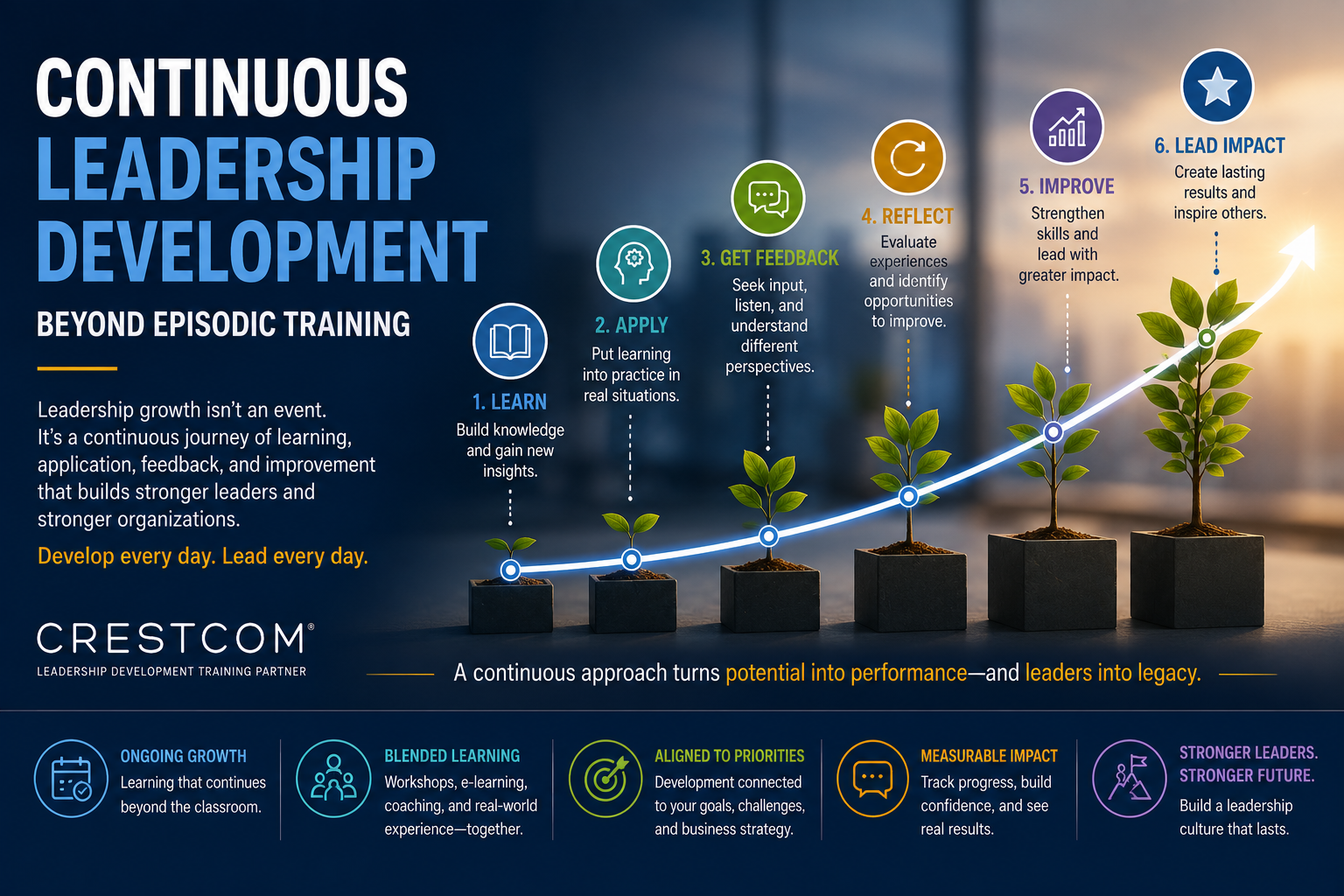
Many organizations still approach leadership development as a series of isolated workshops—annual seminars, one-time retreats, or short training programs designed to “fix” leadership gaps quickly.
The problem?
Leadership does not develop in a day.
True leadership capability is built through repetition, reflection, feedback, and application over time. This is why the most effective organizations are moving away from episodic training and toward continuous leadership development—an approach where learning is embedded into daily work and reinforced consistently.
A high-impact leadership development training program should not be an event. It should be a system.
Why Continuous Leadership Development Matters
Traditional training programs often create temporary motivation but limited behavioural change. Without reinforcement, most learning fades quickly.
Continuous leadership development solves this by creating an ongoing cycle of:
- Learning
- Application
- Feedback
- Reflection
- Reinforcement
According to research from Harvard Business Publishing, leadership development programs are significantly more effective when learning is tied to real business challenges and reinforced over time¹.
This is because leadership growth happens through practice—not presentation.
Crestcom explores this same principle in Mastering Leadership Development: Step-by-Step Guide to Creating Future-Ready Leaders
Building Leadership Learning Journeys Instead of One-Off Programs
"The best organizations create leadership learning journeys, not standalone training sessions."
A learning journey is a structured development pathway that unfolds over months—not hours.
What it includes:
- Monthly learning modules
- Leadership coaching sessions
- Peer accountability groups
- Reflection exercises
- Business application assignments
- Follow-up assessments
This approach ensures leaders don’t just understand concepts—they apply them.
Crestcom’s leadership development philosophy follows this same model through consistent monthly reinforcement and practical implementation.
This connects closely with Designing Personal Leadership Development Pathways because development becomes intentional rather than reactive.
Blended Learning Approaches That Drive Real Leadership Growth
Continuous leadership development works best through blended learning, where multiple development methods work together.
1. Virtual Learning
Short, focused digital learning modules improve accessibility and support remote teams.
2. In-Person Workshops
Live sessions create stronger collaboration, discussion, and accountability.
3. Coaching and Mentoring
Personalized coaching helps leaders apply learning to real workplace challenges.
4. Peer Learning
Leaders grow faster when they learn from one another through shared experiences.
5. Experiential Learning
Action learning projects, stretch assignments, and real business challenges create the deepest leadership growth.
This “learn → apply → reflect → improve” model creates lasting capability rather than short-term inspiration.
Crestcom expands on this in the article Designing Tailored Learning Experiences for Leadership Training
Real-World Examples of Continuous Leadership Development in Action
Example 1: Microsoft – Growth Mindset Through Continuous Leadership Learning
Microsoft shifted its leadership culture by embedding continuous learning into leadership expectations.
How the model is used:
- Leadership development is built around a “learn-it-all” growth mindset
- Managers receive continuous coaching, feedback, and leadership reflection opportunities
- Leadership capability is reinforced through regular development cycles rather than isolated programs
Crestcom Alignment
This mirrors Crestcom’s belief that leadership development must be reinforced continuously to create behavioural transformation.
Example 2: IBM – Personalized Continuous Learning Pathways
IBM uses structured leadership learning pathways supported by digital learning platforms and coaching.
How the model is used:
- Leaders follow personalized learning journeys aligned with business priorities
- Development includes coaching, skills progression, and role-based learning paths
- Continuous reskilling supports leadership agility in fast-changing environments
Crestcom Alignment
This reflects Crestcom’s approach of aligning leadership development with both individual growth and organizational strategy.
Example 3: Deloitte – Leadership Development Through Real Work
Deloitte integrates leadership learning directly into client work, stretch projects, and collaborative development.
How the model is used:
- Leaders learn through live business challenges
- Development is reinforced through coaching and peer learning
- Leadership growth is tied to business outcomes, not training completion
Crestcom Alignment
Crestcom similarly emphasizes leadership development through practical workplace application—not classroom theory alone.
Embedding Leadership Development into Daily Work
The strongest leadership programs make development part of the job itself.
This includes:
- Strategic projects
- Stretch assignments
- Team leadership challenges
- Real-time coaching
- Feedback loops tied to performance
When leadership learning is embedded into real work, development becomes measurable, scalable, and sustainable.
This aligns with Embedding Feedback Loops and Measuring Impact in Leadership Development where continuous feedback strengthens long-term results.
FAQs
1. What is continuous leadership development?
It is an ongoing leadership growth process built through repeated learning, coaching, feedback, and real-world application over time.
2. Why is continuous learning better than one-time leadership training?
Because sustained reinforcement creates behavioural change, while one-time events usually create only short-term motivation.
3. What is a leadership learning journey?
A structured long-term pathway that combines training, coaching, reflection, and workplace application.
4. What are blended leadership learning approaches?
They combine virtual learning, workshops, coaching, peer learning, and experiential projects for stronger development outcomes.
5. How do organizations measure continuous leadership development?
Through leadership assessments, engagement scores, business performance, feedback systems, and observable behaviour change.
Citations & References
- Harvard Business Publishing.
How to Create a Successful Leadership Development Program.
https://www.harvardbusiness.org/insight/how-to-create-a-successful-leadership-development-program/ - McKinsey & Company.
The Leadership Gap: Building Leadership Capability for the Future.
https://www.mckinsey.com/capabilities/people-and-organizational-performance/our-insights - Forbes.
Why Personalized Leadership Development Is the Future of Work.
https://www.forbes.com/councils/forbescoachescouncil/2025/06/20/leading-in-the-ai-era-why-human-centered-leadership-is-the-skill-of-the-future/ - Nielsen.
Global Talent Trends and Employee Engagement Insights.
https://www.nielsen.com/about-us/responsibility-and-sustainability/report/ - Unilever.
Leadership Development and Purpose-Driven Growth Framework.
https://quarterdeck.co.uk/articles/what-leadership-style-does-unilever-use/
What’s Next in the Leadership Development System Series
Continuous leadership development ensures leaders keep learning—but some of the most powerful leadership growth happens when leaders are challenged beyond their comfort zones.
In “Leveraging Stretch Assignments for Leadership Growth,” we explore how real-world responsibility, cross-functional challenges, and high-stakes projects accelerate leadership capability faster than traditional training alone.
➡
Continue the series:
Continue Expanding Your Leadership Perspective
"Great leaders never stop learning."
Explore more expert insights, proven frameworks, and actionable strategies on Leadership Development designed to elevate your leadership impact.
Interested in a free Leadership Skills Workshop with your team?
- Address instantly fixable issues that impact customer perceptions and employee morale.
- Learn and practice a habit that will raise employee performance.
- Set actions with specific and measurable steps that they'll gladly be accountable to achieve.