How to Measure the ROI of Leadership Development Training in Your Canadian Organization
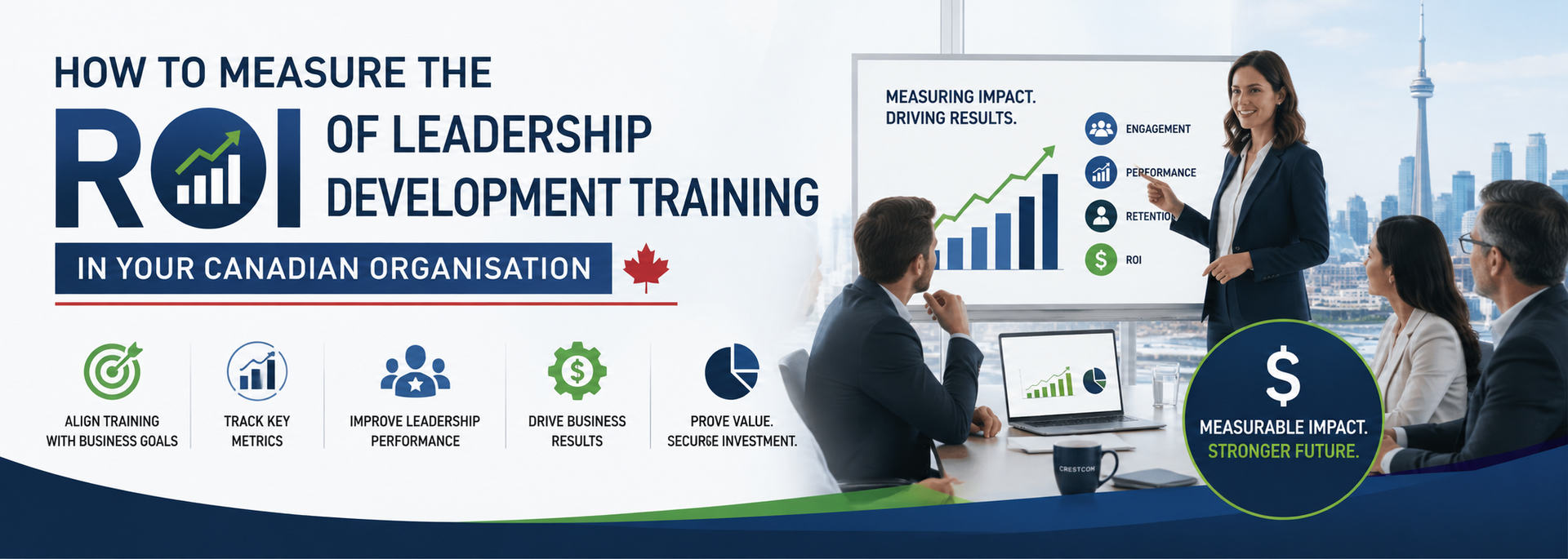
When the CFO asks what the organization is getting back from its investment in leadership development training, how prepared is your answer? For HR Directors and L&D leaders across Canada, that question is no longer hypothetical — it is a standing agenda item in budget conversations heading into 2026.
The shift in expectations is well-documented. According to LinkedIn's 2026 Workplace Learning Report, 67% of L&D leaders struggle to demonstrate training impact to their executives. And yet the stakes have never been higher: leadership development ROI in Canada has become the central test of whether people development is treated as a strategic investment or a discretionary expense. organizations that cannot answer the CFO's question credibly risk losing the budget — and the leadership capabilities that come with it.
This article provides a practical, Canadian-context framework for measuring the ROI of your leadership development program — from the metrics that matter most to the tools and timelines that make measurement credible and actionable.
Why Measuring Leadership Development ROI in Canada Has Become Non-Negotiable
Budget scrutiny has intensified. Across Canadian organizations of every size — from mid-market SMEs to national enterprises — L&D investments are under the same rigorous review as any other operational expenditure. Senior leaders want evidence, not anecdote.
The pressure is compounded by a finding from Deloitte that is difficult to ignore: 77% of executives believe skills are critical to their organization's long-term success, yet only 20% say their current skills strategy is effective. That gap is not primarily a training delivery problem. It is a measurement problem. organizations are investing in development without the frameworks to prove whether it is working.
For Canadian HR Directors and Operations Heads, this creates a specific challenge. Without credible ROI measurement, leadership development budgets are vulnerable — and the managers who need development the most go without it. The organizations that build measurement into their programs from the start are the ones that retain budget, retain talent, and build the leadership pipelines that sustain long-term performance.
LINKEDIN WORKPLACE LEARNING REPORT 2026
67% of L&D leaders struggle to demonstrate training impact to their executives.
Source: LinkedIn Workplace Learning Report 2026
The Kirkpatrick Model: A Practical Framework for Canadian Organizations
The most widely used framework for measuring training effectiveness globally is the Kirkpatrick Model — a four-level evaluation approach that moves from learner reaction through to tangible business results. Originally developed by Dr. Donald Kirkpatrick and updated as the New World Kirkpatrick Model, it provides a structured, credible basis for connecting development activity to organizational outcomes.
For Canadian organizations evaluating leadership development ROI, the Kirkpatrick framework offers a clear architecture for measurement. A fifth level — financial ROI calculation — is often added for programs where board-level justification is required.
The table below outlines how each level applies in practice to a leadership development program:

Where Most organizations Stop — and Why It Costs Them
The most common failure point is stopping at Level 1 — collecting post-session satisfaction surveys and reporting them as evidence of impact. Completing a training program is not the same as applying new behaviours. Applying new behaviours is not the same as driving business results. Yet many L&D reporting frameworks never progress beyond participant feedback scores.
According to Deloitte, 95% of L&D organizations do not excel at using data to align learning with business objectives. Even more concerning, 69% lack the skills to ask the questions that link learning outcomes to business results. This is precisely the gap that credible ROI measurement frameworks are designed to close.
The organizations that get this right build measurement in from the beginning — before the program starts — by establishing baselines, defining the business outcomes the training is intended to influence, and creating the data infrastructure to track change over time.
DELLOITTE RESEARCH
77% of executives believe skills are critical to long-term success. Only 20% say their current skills strategy is effective.
Source: Deloitte, Human Capital Trends Research
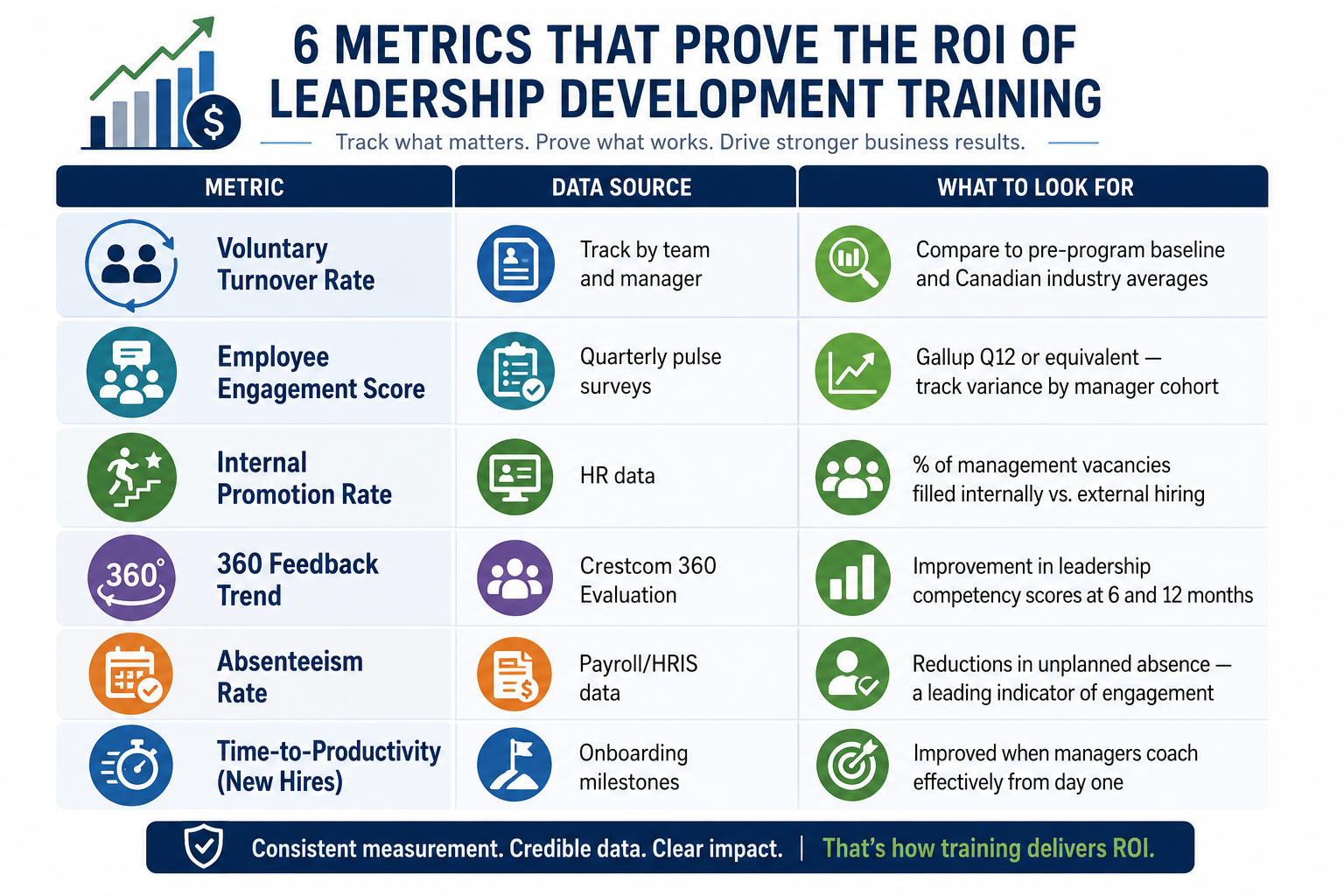
The Six Metrics That Matter Most for Leadership Development ROI
When it comes to measuring leadership development ROI in a Canadian organizational context, not all metrics carry equal weight. The most credible ROI cases are built on a combination of leading indicators — metrics that respond relatively quickly to changes in management behaviour — and lagging indicators that reflect sustained business impact over time.
The table below presents the six metrics most directly linked to the return on management training investment, along with the data sources and benchmarks that give them credibility:
The Canadian Benchmarks That Matter
For Canadian organizations building an ROI case, local benchmarks provide essential context. Voluntary turnover in Canada sat at 11.9% in 2024 (Canadian HR Reporter), down from 15.5% the previous year. With the average cost of replacing a single employee estimated at $30,674 annually (Express Employment Professionals, 2024), even a modest reduction in management-driven turnover produces a measurable, defensible financial return.
Similarly, Gallup's research consistently shows that teams managed by people who have received structured development have measurably higher engagement scores. Given that highly engaged teams produce 21% higher profitability, the financial chain from management training investment to business outcome is traceable - provided the measurement infrastructure is in place to capture it.
Building Your Leadership Development ROI Measurement Plan
Measurement is most powerful when it is built into program design from the outset, not retrofitted after the fact. The following four-step approach provides a practical starting point for Canadian organizations.
Step 1: Define Business Outcomes Before the Program Starts
Begin by identifying the two or three organizational outcomes the program is intended to improve — not learning outcomes, but business outcomes. Examples include: reducing voluntary turnover in manager-led teams by 15% within 12 months; improving employee engagement scores in targeted business units; or increasing the proportion of leadership vacancies filled through internal promotion. This step applies equally whether you are investing in structured group training, a modular leadership series, or a senior executive strategy program. For a fuller picture of how to align program selection with organizational outcomes, Crestcom Canada's resource on building future-ready leaders provides a practical starting point.
These outcomes become the anchor for all subsequent measurement. They also frame the conversation with your CFO or board in language they recognise.
Step 2: Establish Baselines Before Training Begins
ROI measurement without a baseline is comparison without context. Before your leadership program begins, capture the current state of your target metrics — engagement scores, voluntary turnover rates, 360 feedback results, internal promotion rates. A tool like theCrestcom 360 Evaluation is specifically designed to establish these baselines in a structured, consistent way, providing the pre-program benchmark that makes post-program improvement attributable and credible — regardless of which Crestcom program your organization selects.
Step 3: Build Milestone Check-Ins at 30, 60, 90 Days and 12 Months
Behaviour change takes time. The most reliable measurement approach captures progress at structured intervals: 30 and 60 days post-program for initial behavioural shifts, 90 days for early business metric movement, and 12 months for a full cycle of organizational impact data.
This is one of the structural advantages of Crestcom Canada's extended development programs. Whether an organization selects theCrestcom LEADER program for frontline and mid-level managers, the Crestcom Leadership Series for teams seeking structured, modular development, or theCrestcom Strategy program for senior executives and C-suite leaders, each program embeds development over an extended period rather than delivering it as a one-time event. This means natural measurement checkpoints are built into the program architecture — so ROI tracking becomes a by-product of delivery, not an additional burden.
Step 4: Report in Business Language, Not Training Language
When presenting ROI to senior stakeholders, translate training metrics into financial and operational language. Rather than reporting that 94% of participants rated the program highly, report that average voluntary turnover in trained manager cohorts fell by X percentage points in the 12 months following program completion, representing an estimated saving of $Y in replacement costs. That is the language that earns budget protection.
Frequently Asked Questions: Leadership Development ROI Canada
What does leadership development ROI actually mean, and how is it calculated?
Leadership development ROI refers to the measurable business return generated by an investment in management and leadership training, expressed relative to the cost of the program. In practice, it is calculated by quantifying the financial value of outcomes produced — such as reduced voluntary turnover, improved team productivity, or increased internal promotion rates — and comparing that figure to the total program cost. The Phillips ROI Model provides a fifth-level extension to the Kirkpatrick framework specifically designed to produce this financial calculation for high-investment programs such as leadership development.
How long does it take to see a measurable ROI from leadership training in Canada?
Initial behavioural shifts can be observed at the 30- to 90-day mark following program completion. Meaningful business metric movement — such as engagement score improvements or turnover rate reductions — typically becomes visible within six to twelve months. This is why extended, structured programs — such as the Crestcom LEADER and Leadership Series for managers, or the Crestcom Strategy program for senior executives — are better positioned to demonstrate full ROI than single-event workshops: the extended development timeline aligns naturally with the measurement horizon required to capture and report organizational impact.
What metrics should Canadian HR Directors track to measure training effectiveness?
The most credible metrics for measuring leadership development effectiveness in a Canadian context include voluntary turnover rates (tracked by manager cohort), employee engagement scores (quarterly pulse surveys or Gallup Q12), 360-degree feedback trends at six and 12 months, internal promotion rates, absenteeism trends, and time-to-productivity for new hires managed by program participants. These metrics combine leading indicators of behaviour change with lagging indicators of business impact, giving HR Directors a complete picture of both short- and long-term return.
Why do most organizations struggle to prove the ROI of their leadership programs?
The most common reason is that measurement is not built into the program from the start. Without pre-program baselines, defined business outcome targets, and structured measurement checkpoints, it becomes impossible to isolate and attribute the impact of training. Compounding this, many L&D teams report in training language — completion rates and satisfaction scores — rather than in the business and financial language that resonates with CFOs and boards. The solution is a measurement-first approach: define the outcome, establish the baseline, structure the check-ins, and translate results into financial terms.
How does the Crestcom 360 Evaluation support ROI measurement?
The Crestcom 360 Evaluation is a structured leadership assessment tool that provides multi-directional feedback on a manager's performance across key competency areas. It is designed to be administered both before and after a development program, creating a measurable before-and-after comparison that documents growth, identifies residual gaps, and provides the evidence base required to demonstrate program effectiveness. It integrates naturally with any Crestcom program — whether that is the LEADER program for frontline managers, the Leadership Series for team-wide development, or the Strategy program for senior executives — giving organizations the data infrastructure needed to report leadership development ROI with confidence to senior stakeholders.
Is leadership development ROI measurable for smaller Canadian businesses?
Absolutely. The principles of measurement apply regardless of organization size. For Canadian SMEs, the most practical starting point is tracking two or three key metrics — typically voluntary turnover by team and quarterly engagement pulse results — before and after a structured program. Even in organizations with 50 to 200 employees, a single manager's development producing measurable improvement in their team's retention and engagement can represent a return that substantially exceeds the program cost. Crestcom Canada's programs are designed to serve organizations at all scales, with measurement frameworks that are practical and proportionate to the resources available.
-------------------------
TAKE THE NEXT STEP
-------------------------
If your organization cannot currently answer the CFO's ROI question with confidence, that is the gap worth closing first.
Crestcom Canada's programs are built with measurement in mind — providing the frameworks, tools, and structured timelines that give HR Directors the evidence base they need to demonstrate genuine leadership development ROI to senior stakeholders.
Explore Crestcom Canada's full range of leadership development training programs — including the LEADER program for managers, the Leadership Series for structured team development, and the Strategy Leadership program for senior executive development.
Or learn how the Crestcom 360 Evaluation can establish the baseline your ROI measurement framework needs.
Ready to build the business case? Contact the Crestcom Canada team to discuss a program and measurement plan tailored to your organization.
Ready to build the business case?
Contact the Crestcom Canada team to discuss a program and measurement plan tailored to your organization.
Interested in a free Leadership Skills Workshop with your team?
- Address instantly fixable issues that impact customer perceptions and employee morale.
- Learn and practice a habit that will raise employee performance.
- Set actions with specific and measurable steps that they'll gladly be accountable to achieve.