Why Human Leadership Skills Matter More Than Ever in Canada's AI-Driven Workplace
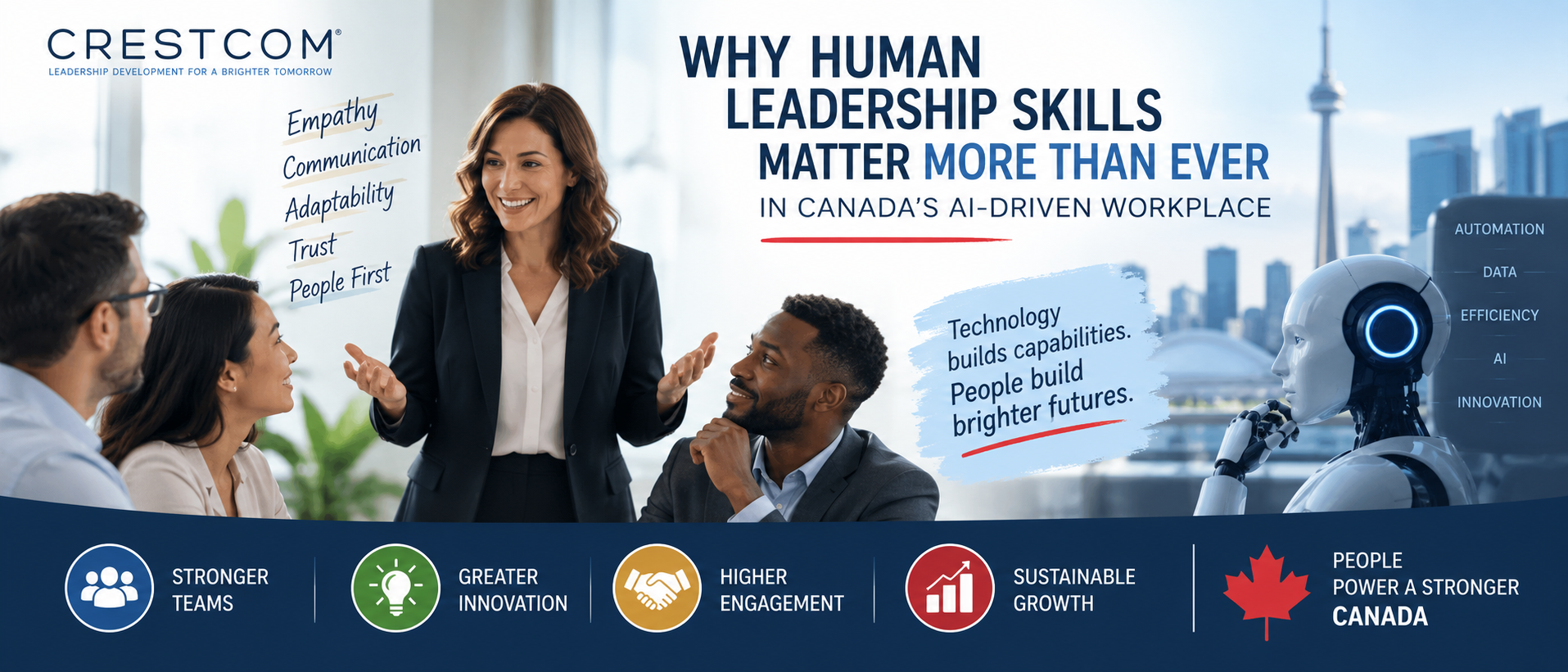
If you follow leadership conversations in Canada right now, you have noticed a pattern: every major research firm — from McKinsey and the World Economic Forum to DDI and Gallup — is saying the same thing at once. Artificial intelligence is not diminishing the value of human leadership in the workplace. It is amplifying it.
PwC's 2025 Global AI Jobs Barometer — based on analysis of close to a billion job advertisements across six continents — found that workers with AI-relevant skills command a 56% wage premium over comparable roles. But the same research reveals something that should be at the centre of every Canadian HR Director's leadership strategy: the tasks most valued in AI-exposed roles are not technical. They are distinctly human. Judgement. Empathy. Communication. Accountability. Leadership.
For organisations investing in leadership skills for an AI-driven workplace in Canada, this is not a distant concern. The question is not whether AI will change how your managers lead — it already is. The question is whether your managers are being developed for the leadership environment that now exists.
What AI Is Actually Doing to Leadership Demands in Canada
The narrative that AI eliminates jobs and reduces demand for human skill misreads the data. PwC's 2026 Global AI Jobs Barometer found that headcount growth at companies most exposed to AI is actually outpacing growth at the least AI-exposed companies — 52% relative to 36% since 2018. These organisations are not reducing their human workforce. They are raising the bar for it.
The skills being demanded are shifting. AI absorbs routine, analytical, and process-driven tasks — freeing human capacity for the work that requires wisdom, empathy, and relational intelligence. PwC's research found that the new tasks added to AI-exposed roles are 2.5 times more likely to rely on distinctly human capabilities such as empathy, judgement, and creativity.
The World Economic Forum's Future of Jobs Report 2025 recorded the largest single shift in its report history: leadership and social influence saw a 22 percentage-point increase in the share of respondents identifying these as core skills. Four of the five fastest-growing skills for 2030 — creative thinking, resilience, curiosity, and leadership — are capabilities that AI cannot replicate.
For Canadian organisations managing AI-augmented teams, this creates a specific and urgent challenge: developing managers whose human skills are strong enough to lead in an environment where the routine work has been delegated to machines, but the relational, cultural, and strategic work rests entirely on them.
PwC GLOBAL AI JOBS BAROMETER 2026
AI-exposed junior roles are 7x more likely to require traditionally senior-level skills — including leadership, judgement, and strategic thinking.
Source: PwC, 2026 Global AI Jobs Barometer (analysis of 1 billion+ job ads, 27 countries)
The Six Human Leadership Skills That Define AI-Era Success
Not all human skills hold equal weight in an AI-augmented leadership context. The following six capabilities are identified consistently across McKinsey, WEF, DDI, and PwC research as the leadership competencies that AI amplifies demand for — rather than replaces.
The infographic below maps each skill to its organisational impact and the specific gap that AI cannot fill:

Why Empathy Is the Defining Leadership Skill of 2026
McKinsey's research on developing human leadership in the age of AI makes the point directly: organisations must actively cultivate core leadership qualities such as wisdom, empathy, and trust — and give these attributes the same attention they give to the development of new IT systems. This is not a values argument. It is a performance argument.
When managers cannot demonstrate empathy and psychological safety, teams exposed to AI-driven change disengage. Gallup research confirms that manager behaviour is the single largest driver of team engagement variance. In a workplace where AI is reshaping roles and creating uncertainty, the manager's ability to listen actively, communicate honestly, and create safety is not a soft skill — it is a business-critical capability.
Ask yourself: when your organisation introduced its last significant technology change, what was the primary factor that determined whether teams adapted quickly or resisted it? Almost universally, the answer is the quality of the manager in the room.
Coaching as the Core Management Competency for AI-Augmented Teams
As AI takes on more of the execution and analysis work within teams, the manager's role shifts from directing to developing. The most valuable managers in an AI-driven workplace are those who can identify their team members' potential, create stretch opportunities, and coach consistently — not just review performance annually.
This mirrors what Crestcom Canada explores in depth in Designing Personal Leadership Development Pathways: effective development is personal, continuous, and tied directly to individual career trajectories. In an AI-augmented environment, this kind of manager-as-coach relationship becomes the primary vehicle through which people grow — because the routine competency gains are increasingly automated.
WORLD ECONOMIC FORUM — FUTURE OF JOBS REPORT 2025
Leadership and social influence saw the largest ever recorded increase in the WEF's report series — a 22 percentage-point rise in the share of respondents identifying these as core skills.
Source: World Economic Forum, Future of Jobs Report 2025)
The Human-Centred Leadership Skills Gap in Canadian Organisations
If the research makes the case this clearly, why are so many Canadian organisations still under-investing in the human dimensions of leadership development? The gap is not one of awareness — most HR Directors and L&D leaders understand the argument. It is a gap in execution.
Three patterns repeat across Canadian organisations of all sizes:
Pattern 1: AI Fluency Is Being Prioritised Over Leadership Fluency
Budget and attention are flowing toward AI upskilling — tool adoption, prompt engineering, and data literacy. These investments are valuable. But they are being made at the expense of, rather than alongside, the human leadership development that gives those tools their value. A team led by a manager who cannot communicate change, coach through uncertainty, or build trust will not realise the productivity gains that AI investment promises.
Pattern 2: Leadership Development Is Still Treated as an Event
The capabilities that matter most in an AI-driven workplace — empathy, coaching, change leadership, and strategic judgement — are not built in a two-day workshop. They develop through sustained practice, feedback, peer accountability, and repeated application over time. Organisations that invest in one-time training events and expect durable behaviour change are consistently disappointed.
This is the core argument behind the Crestcom approach to continuous leadership development: the leadership capabilities that matter most — especially those that complement rather than compete with AI — require a sustained development journey, not an episodic intervention.
Pattern 3: Assessment Is Missing From the Development Equation
Organisations cannot develop human leadership skills they have not first diagnosed. Without structured assessment — 360-degree feedback, competency mapping, and behavioural baseline data — development programmes target the wrong capabilities or fail to track meaningful progress.
As Crestcom's guide to using assessment and 360° feedback in leadership development explains, assessment is not a precursor to development — it is the foundation that makes development purposeful. In an AI-driven leadership context, this is especially true: the specific human skills a manager needs to develop should be identified with the same rigour as any other business capability gap.
What Management Training in Canada Must Look Like in an AI-Driven Workplace
The implication of the research is clear. Management training in Canada that is fit for an AI-driven workplace must be built on a different set of priorities than the training programmes that served the previous decade well. Three requirements stand out.
Requirement 1: Human Skills at the Centre, AI Literacy as a Complement
Effective leadership development in 2026 does not ignore AI. But it treats human skill development as the primary investment and AI literacy as a valuable complement — not the other way around. The managers who will create the greatest value in AI-augmented organisations are those who combine strong relational intelligence with the ability to work productively alongside intelligent tools.
For organisations looking to build this balance, the framework explored in Building Future-Ready Leaders provides a practical starting point — addressing how leadership development programmes can equip managers for the full range of challenges that the current business environment presents, including the transition to AI-augmented operations.
Requirement 2: Blended Learning That Builds Durable Human Capabilities
The human skills that matter most in an AI-driven workplace are developed through practice, feedback, and peer learning — not through content delivery alone. Effective management training programmes use a blended approach: structured learning combined with coaching, real-world application, and accountability partnerships that sustain development between formal sessions.
Crestcom Canada's article on blended learning approaches that drive real leadership growth outlines why this structure produces superior results — and why the combination of virtual learning, in-person workshops, peer learning cohorts, and experiential application creates the conditions in which human leadership capabilities genuinely take root.
Requirement 3: Competency Models That Reflect the AI Era
Leadership competency frameworks that were built for a pre-AI environment are not adequate guides for leadership development in 2026. Organisations need competency models that explicitly include the human capabilities — empathy, psychological safety, change leadership, coaching — that become more valuable as AI handles more of the technical workload. The guide to defining leadership principles and competency models offers a practical framework for building or refreshing the competency architecture that underpins an effective leadership development system.
Frequently Asked Questions: Leadership Skills for Canada's AI-Driven Workplace
What human leadership skills are most important in an AI-driven workplace?
The leadership skills most consistently identified by global research as critical in AI-augmented environments are empathy and psychological safety, coaching and developing others, communication and active listening, accountability and follow-through, change leadership, and strategic thinking and judgement. These are the capabilities that AI amplifies demand for rather than substitutes — because they require the relational intelligence, contextual awareness, and ethical judgement that machines cannot replicate. For Canadian organisations developing their leadership capability frameworks, these six areas represent the highest-return development investment.
Why are human leadership skills becoming more valuable as AI adoption increases?
As AI absorbs more routine analytical and process-driven tasks, the proportion of each manager's role that involves human-intensive work increases. PwC's 2026 research found that the new tasks added to AI-exposed roles are 2.5 times more likely to rely on empathy, judgement, and creativity. The World Economic Forum recorded its largest ever skills shift — a 22 percentage-point increase in leadership and social influence as core skills. The conclusion is consistent: AI does not reduce the need for strong human leadership. It makes it the decisive competitive differentiator.
How should Canadian organisations balance AI upskilling and human leadership development?
Both are necessary — but they serve different purposes and should not be treated as competing investments. AI upskilling builds tool fluency. Human leadership development builds the relational, cultural, and strategic capabilities that determine how effectively those tools are adopted, governed, and leveraged. The organisations that see the greatest return on AI investment are those whose leaders can communicate change effectively, build trust through uncertainty, coach teams through new ways of working, and exercise sound judgement on when and how to apply AI outputs. Without strong human leadership, AI investment underperforms.
Is management training in Canada keeping pace with the demands of AI-augmented workplaces?
Research suggests a growing gap. Many Canadian organisations are accelerating AI tool adoption while allowing leadership development budgets to stagnate or be redirected. This creates a widening capability gap: technically equipped teams led by managers who lack the coaching, communication, and change leadership skills to realise the full potential of those tools. Structured, accountable management training programmes — designed specifically to develop human-centred leadership capabilities — are the mechanism through which this gap is closed.
What role does psychological safety play in AI adoption within Canadian organisations?
Psychological safety — the team environment in which people feel safe to speak up, ask questions, and make mistakes — is a direct enabler of AI adoption. Teams led by managers who create high psychological safety adapt to new technologies faster, surface implementation problems earlier, and generate more of the creative and innovative applications that create organisational value. Teams led by managers who have not developed this capability resist change, under-report problems, and fail to realise the potential of the tools they are given. Building psychological safety is a leadership development priority — not an HR wellness initiative.
How can Crestcom Canada help organisations develop human-centred leadership skills for the AI era?
Crestcom Canada's programmes are specifically designed to develop the human leadership capabilities that complement AI adoption: coaching, communication, accountability, change leadership, and strategic judgement. The 12-month Crestcom LEADER programme builds these capabilities through structured, accountable development embedded across an extended period — producing durable behaviour change rather than temporary awareness. The Crestcom 360 Evaluation establishes the baseline and tracks progress, while the Leadership Series and Strategy Programme serve team-wide and senior executive development needs respectively. For organisations navigating the shift to AI-augmented operations, these programmes provide the human development infrastructure that makes the technology investment pay.
References
1. PwC. '2025 Global AI Jobs Barometer.' PwC Global, June 2025.
2. PwC. '2026 Global AI Jobs Barometer.' PwC Global, June 2026.
3. McKinsey & Company. 'Developing Human Leadership in the Age of AI.' McKinsey, January 2026.
4. World Economic Forum. 'Future of Jobs Report 2025.' World Economic Forum, 2025.
5. Gallup. 'State of the Global Workplace: 2025 Report.' Gallup Inc., 2025.
Interested in a free Leadership Skills Workshop with your team?
- Address instantly fixable issues that impact customer perceptions and employee morale.
- Learn and practice a habit that will raise employee performance.
- Set actions with specific and measurable steps that they'll gladly be accountable to achieve.