Using Assessment & 360° Feedback in Leadership Development
Defining leadership principles and competency models is the first step in building an effective leadership development system. But once expectations are clear, organizations must answer a critical question:
Where do our leaders stand today?
This is where leadership assessment and 360° feedback become essential. Without objective insight, leadership development becomes guesswork. With it, organizations can identify gaps, build targeted development plans, and drive measurable behavioural change.
Why Assessment & 360° Feedback Are Critical in Leadership Development
Leadership principles Leadership development is not just about learning—it’s about behaviour change. And behaviour change requires awareness.
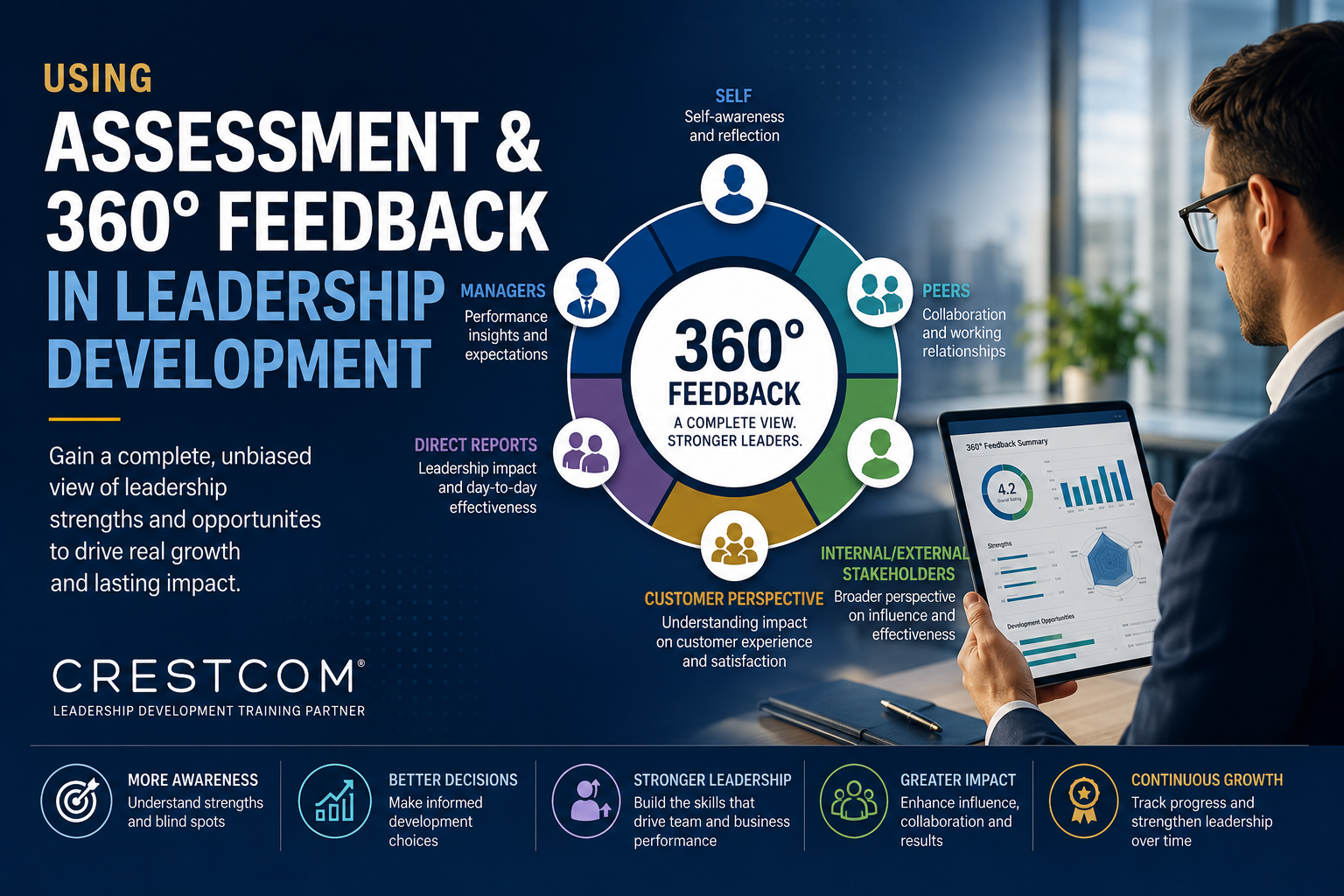
360° feedback provides leaders with perspectives from:
- Managers
- Peers
- Direct reports
- Self-assessment
This multi-dimensional view reveals blind spots, strengths, and behavioural patterns that traditional evaluations often miss.
Organizations that embed feedback into leadership development systems consistently see:
- Higher engagement
- Stronger leadership alignment
- Faster capability development
This reinforces insights discussed in Crestcom’s article on Mastering Leadership Development: Step-by-Step Guide to Creating Future-Ready Leaders
Best Practices in Leadership Assessments
To be effective, leadership assessments must be structured, consistent, and aligned with organizational goals.
1. Align Assessments with Competency Models
Assess what matters. Every assessment should map directly to defined leadership competencies.
2. Use Multi-Source Feedback
360° feedback ensures a holistic and unbiased perspective.
3. Maintain Psychological Safety
Feedback should be constructive and confidential to encourage honesty.
4. Conduct Assessments Regularly
Leadership development is continuous—annual reviews are not enough.
5. Avoid Data Overload
Focus on actionable insights rather than overwhelming leaders with excessive metrics.
These principles align closely with the structured approach outlined in Designing Tailored Learning Experiences for Leadership Training
Assessing Organizational Readiness for Leadership Development
Before implementing assessment systems, organizations must evaluate their readiness.
Key readiness factors include:
- Leadership alignment: Are senior leaders committed to development?
- Cultural openness: Is feedback accepted or resisted?
- Infrastructure: Are systems in place to support assessment and follow-up?
- Clarity of goals: Are leadership expectations clearly defined?
Without readiness, even the best assessment tools will fail to deliver results.
Crestcom explores this in detail in Assessing Organizational Readiness for Leadership Development
How to Interpret and Act on 360° Feedback
Collecting feedback is only the beginning. The real value lies in how it is interpreted and applied.
Step 1: Identify Patterns, Not Isolated Comments
Look for consistent themes across multiple feedback sources.
Step 2: Prioritize Development Areas
Focus on 2–3 key behaviours that will have the greatest impact.
Step 3: Create a Development Plan
Translate feedback into actionable goals with measurable outcomes.
Step 4: Reinforce Through Coaching
Coaching ensures accountability and sustained behaviour change.
Step 5: Track Progress Over Time
Follow-up assessments help measure improvement and maintain momentum.
These feedback loops are essential for long-term success, as highlighted in Embedding Feedback Loops and Measuring Impact in Leadership Development
Real-World Examples of Leadership Assessment in Action
Leadership assessment frameworks deliver the greatest value when they move beyond evaluation and become drivers of behavioural change, performance improvement, and leadership accountability. The following real-world examples illustrate how leading organizations embed assessment and 360° feedback into their leadership systems—an approach that closely aligns with Crestcom’s philosophy of measurable, applied leadership development.
Example 1: Technology Sector – Data-Driven Leadership Feedback Systems
Organizations like Google have set a global benchmark for using structured leadership assessments to improve managerial effectiveness. Through its well-known Project Oxygen, Google analyzed large datasets of employee feedback to identify the behaviours that define effective leadership.
How the model is used:
- Google gathers multi-source feedback through internal surveys and performance tools to evaluate leadership behaviours such as coaching, communication, and decision-making clarity.
- These behaviours are translated into core leadership competencies, which are then embedded into leadership training and development programs.
- Managers receive structured feedback reports and are supported through coaching and targeted development plans.
- Follow-up assessments track progress, reinforcing continuous improvement.
Impact:
Google reported significant improvements in manager effectiveness and team performance after implementing this system.
Crestcom alignment:
This reflects Crestcom’s belief that leadership development must be
data-driven, behaviour-focused, and reinforced over time—not a one-time training event.
Enterprise insight:
According to Google’s re:Work research, effective managers directly influence employee performance, retention, and engagement—reinforcing the importance of structured feedback systems¹.
Example 2: Global Enterprise Organizations – Leadership Pipeline & Succession Planning
Global organizations such as General Electric have long integrated leadership assessments into talent strategy, making them a core component of succession planning and leadership pipeline development.
How the model is used:
- GE integrates 360° feedback and leadership competency assessments into its talent review process, particularly through its Crotonville leadership institute.
- Leaders are evaluated against competencies such as strategic thinking, execution, and people development.
- Assessment outcomes inform high-potential identification (HiPos), succession decisions, and leadership readiness.
- Leaders are assigned targeted development actions—such as stretch roles and executive coaching—based on feedback insights.
Impact:
GE has consistently produced leaders capable of managing complex global operations, demonstrating the effectiveness of its integrated assessment system.
Crestcom alignment:
Crestcom emphasizes that leadership development should be
linked to real business outcomes and talent decisions, ensuring that assessment drives both growth and performance.
Enterprise insight:
McKinsey research shows that organizations with strong leadership pipelines are
2.4× more likely to outperform peers financially, highlighting the importance of structured assessment systems².
Example 3: Canadian Public Sector – Accountability, Ethics & Leadership Consistency
Public sector organizations in Canada, including the Government of Canada, rely on structured leadership assessment frameworks to ensure accountability, transparency, and consistency across leadership roles.
How the model is used:
- The Government of Canada’s Key Leadership Competencies (KLC) framework defines expected behaviours such as values and ethics, strategic thinking, engagement, and management excellence.
- Leaders are assessed through a combination of performance reviews, behavioural evaluations, and multi-source feedback.
- Assessment outcomes guide executive development programs, leadership training, and succession planning.
- Feedback is used to ensure alignment with public service values and to strengthen leadership accountability across departments.
Impact:
This structured approach ensures leadership consistency across a complex, multi-departmental system while maintaining high standards of governance and public trust.
Crestcom alignment:
Crestcom’s leadership development programs similarly focus on
consistent leadership behaviour across all levels, ensuring that leadership principles translate into daily actions.
Enterprise insight:
Harvard Business Publishing emphasizes that leadership development programs are most effective when
assessment, feedback, and development are integrated into a continuous system, rather than treated as isolated activities³.
What These Examples Mean for Your Organization
Across industries, successful organizations follow a consistent pattern:
- They align assessment with leadership competency models
- They embed feedback into ongoing development—not annual reviews
- They connect assessment outcomes to real decisions (training, promotions, succession)
- They reinforce behaviour change through coaching and application
This is precisely the approach Crestcom brings to leadership development—helping organizations move from insight to action, and from training to measurable impact.
👉 Organizations that adopt this model don’t just assess leaders—they develop leaders who consistently drive engagement, performance, and results.
Integrating Assessment into Leadership Development Systems
Assessment should not be a one-time activity—it must be embedded into the leadership development system.
Organizations that succeed:
- Integrate feedback into training programs
- Align assessments with performance management
- Use coaching to reinforce behavioural change
- Create continuous feedback loops
When assessment becomes part of the system, leadership development becomes measurable, scalable, and sustainable.
FAQs
1. What is 360° feedback in leadership development?
360° feedback is a multi-source evaluation method that gathers input from managers, peers, direct reports, and self-assessment to provide a comprehensive view of leadership behaviour.
2. How often should leadership assessments be conducted?
Most organizations conduct them annually or bi-annually, with continuous informal feedback in between.
3. What are the biggest mistakes in leadership assessments?
Common mistakes include lack of follow-up, misalignment with competencies, and failure to act on feedback.
4. Can 360° feedback improve leadership performance?
Yes, when combined with coaching and development plans, it significantly improves self-awareness and behaviour change.
5. How do you ensure honest feedback in 360° assessments?
By maintaining confidentiality, creating psychological safety, and clearly communicating the purpose of development—not evaluation.
Citations & References
- Google Inc - Manager Effectiveness - https://rework.withgoogle.com/intl/en/subjects/managers
- Google’s Project Oxygen, Part 1: From No Managers to Great Managers and Key Behaviors - https://medium.com/workmatters/googles-project-oxygen-part-1-from-no-managers-to-great-managers-and-key-behaviors-c29061a6f08c
- McKinsey & Company.
Talent & Capability Building
https://www.mckinsey.com/industries/public-sector/how-we-help-clients/talent-and-capabilities - Harvard Business Publishing.
How to Create a Successful Leadership Development Program
https://www.harvardbusiness.org/insight/how-to-create-a-successful-leadership-development-program/ - Government of Canada.
Key Leadership Competencies Framework
https://www.canada.ca/en/treasury-board-secretariat/services/professional-development/key-leadership-competency-profile.html
What’s Next in the Leadership Development System Series
Understanding leadership capability through assessment and 360° feedback is a critical step—but insight alone does not drive growth. The next challenge is translating that insight into a structured and personalized development journey.
In “Designing Personal Leadership Development Pathways,” we explore how organizations can turn feedback into targeted action by creating individualized development plans that align leadership growth with business priorities and career progression.
➡
Continue the series:
Continue Expanding Your Leadership Perspective
"Great leaders never stop learning."
Explore more expert insights, proven frameworks, and actionable strategies on Leadership Development designed to elevate your leadership impact.
Interested in a free Leadership Skills Workshop with your team?
- Address instantly fixable issues that impact customer perceptions and employee morale.
- Learn and practice a habit that will raise employee performance.
- Set actions with specific and measurable steps that they'll gladly be accountable to achieve.