
Navigating the Return-to-Office Reckoning: A Leadership Guide for Canadian Businesses in 2026

Canadian workplaces are living through one of the most consequential and fastest-moving leadership tests in years. Return to office leadership in Canada in 2026 is no longer a hypothetical debate about productivity and culture — it is an active, high-stakes transition playing out simultaneously across the country's largest banks, two provincial governments, and the federal public service, with visible public pushback and a measurable retention risk attached to every misstep.
This article takes a balanced view. There are legitimate business reasons driving these mandates — collaboration, mentorship, and culture cited by employers are not manufactured concerns. But the retention risk is equally real: Robert Half Canada research[1]. The question for Canadian HR Directors and CEOs is not whether to have an RTO position — most already do. It is whether the transition is led in a way that protects the people the organization cannot afford to lose.
This guide focuses on exactly that: the specific leadership behaviours — communication, trust-building, and change management — that determine whether an RTO transition succeeds or quietly triggers an exodus of your best people.
What's Actually Happening: Major Bank and Government RTO Mandates in Canada
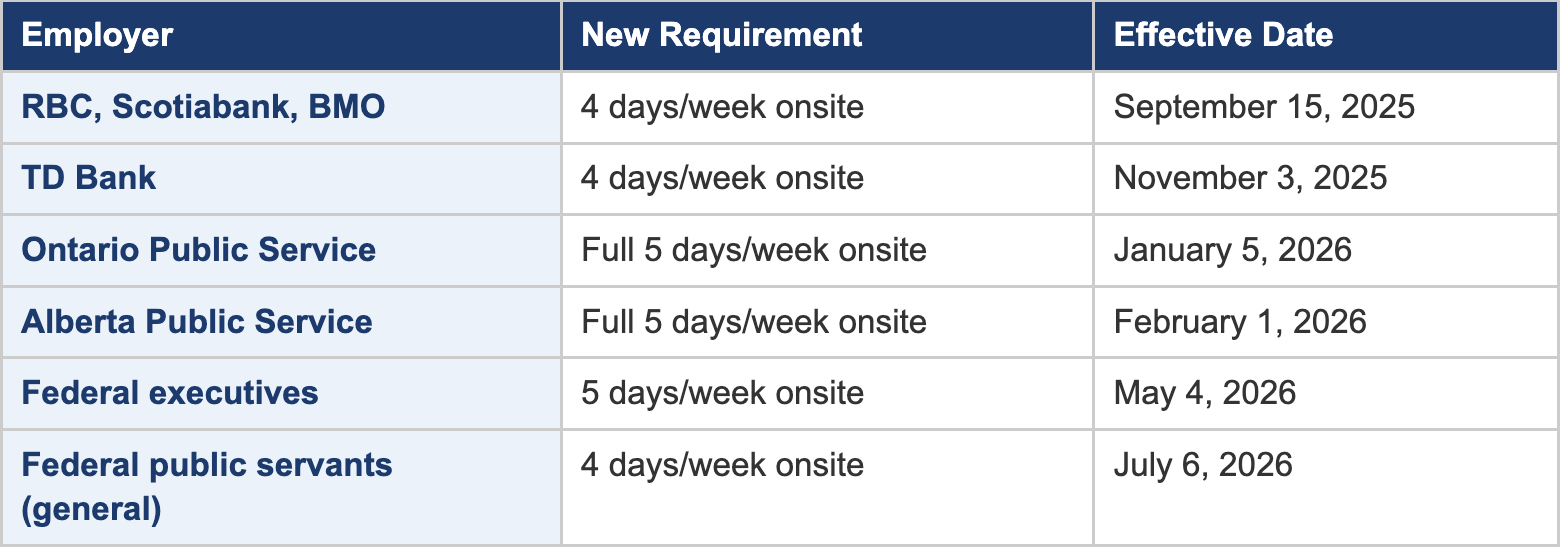
As Policy Options noted in its August 2026 analysis of Canada's fragmented RTO landscape [6] — meaning there is no single national consensus for Canadian employers to point to as precedent.
STATISTICS CANADA — MAY 2026
11.4% of employed Canadians worked exclusively from home, and 9.8% had a hybrid arrangement — meaning roughly one in five Canadian workers still had some form of remote work in place as mandates tightened.
Source: Statistics Canada Labour Force Survey, cited in Policy Options, August 2026
The Retention Risk Leaders Can't Ignore
Public opinion on this issue is genuinely split, not one-sided — and that nuance matters for how leaders should communicate. Angus Reid Institute polling. This is the core leadership challenge: the people closest to the policy are the ones least convinced by it.
The commercial risk is concrete and quantifiable. Robert Half Canada's 2026 research. In other words, flexibility isn't just an attraction factor — for nearly half of Canadian professionals, it is the primary reason they haven't already left.
This pattern is not unique to the public sector. Crestcom Canada's analysis of the hidden cost of undertrained middle managers found that Canadian businesses consistently underestimate how much voluntary turnover is driven by manager behaviour rather than policy itself — and an RTO mandate delivered without skilled, empathetic leadership is exactly the kind of change most likely to convert quiet dissatisfaction into an actual resignation
ROBERT HALL CANADA, 2026
44% of Canadian professionals plan to look for a new job in the second half of 2026 — nearly double the 26% recorded one year earlier.
Source: Robert Half Canada, Canadian Remote Work Statistics and Trends 2026
How to Lead an RTO Transition Without Losing Your Best People
The organizations navigating this transition most successfully are not the ones with the most generous exceptions, nor the ones enforcing mandates most rigidly. They are the ones whose managers lead the change well, regardless of what the underlying policy says. Four leadership behaviours consistently separate a well-led transition from a retention crisis.
1. Explain the 'Why' — Specifically, Not Generically
Generic language about "collaboration" and "culture" is not persuasive on its own — employees have heard it repeatedly and increasingly discount it. Leaders who retain trust through an RTO transition explain the specific business reasoning behind the policy for their team or function, acknowledge openly that the change is unwelcome for many, and are honest about what is and is not negotiable. Vague justification breeds cynicism; specific, honest justification — even when the news itself is unwelcome — preserves trust.
2. Over-Communicate Through the Transition Period
Change management research consistently shows that ambiguity, not the change itself, is often what drives the most anxiety and disengagement. Leaders should communicate timelines, logistics, and expectations repeatedly and through multiple channels — not as a single announcement — and create real opportunities for questions and pushback, rather than treating the policy as closed for discussion the moment it is announced.
3. Address the Practical Friction Directly
Much of the resistance to RTO mandates is not philosophical — it is practical: commuting costs, childcare logistics, desk shortages, and lost focus time. Leaders who acknowledge these frictions directly, and who advocate upward for reasonable accommodations where genuinely possible, are far more likely to retain goodwill than those who treat these concerns as irrelevant to the policy decision.
4. Model the Behaviour, Don't Just Mandate It
Employees watch what leaders do far more closely than what they say. A manager who is visibly present, engaged, and using in-office time purposefully — for mentorship, coaching, and genuine collaboration, not just attendance — builds credibility for the policy in a way that no memo can. A manager who treats in-office days as an administrative box-check sends the opposite signal, and teams notice immediately.
This is particularly critical for leaders managing teams that have shifted from fully remote or hybrid to in-office arrangements, a transition explored in depth in Crestcom Canada's guide to leading remotely and building leader capabilities for distributed and hybrid teams, much of which applies directly to managing the reverse transition back into the office.
Building Trust and Communication Through Policy Change
RTO mandates are, at their core, a trust test for leadership — and trust, once damaged, is far harder to rebuild than it was to maintain. This is precisely the leadership skill gap that RTO transitions expose most clearly: leading through change that is genuinely unpopular with at least part of the team, without either capitulating on necessary business decisions or losing the team's confidence in the process.
This is not a skill most managers develop naturally, particularly those promoted primarily for technical or functional expertise. Building the specific capability to lead through unpopular, policy-driven change requires deliberate development — not a single workshop, but sustained practice in difficult conversations, transparent communication under pressure, and change leadership.
Crestcom Canada's approach to continuous leadership development beyond episodic training speaks directly to why this kind of capability — genuinely leading people through change they did not choose — is built over months of structured practice, not a single session.
Crestcom's approach to leadership development is built specifically around the accountability, peer learning, and structured practice that develop exactly these trust-building and change-management behaviours — the capability gap that RTO transitions are currently exposing across Canadian organizations of every size.
Ask yourself: if your organization announced an RTO policy change tomorrow, are your managers equipped to lead that conversation with their teams — or would most of them simply relay the policy and hope for the best? For most Canadian organizations, the honest answer reveals exactly where the development investment needs to go.
Frequently Asked Questions: Return-to-Office Leadership in Canada
Why are Canadian banks and governments mandating return-to-office in 2026?
Major Canadian employers have cited a consistent set of reasons: strengthening collaboration and mentorship, rebuilding organizational culture, and — particularly at the big banks — supporting downtown commercial real estate and economic activity. RBC has described itself as a "relationship-driven bank" where in-person, human connection is core to its culture, while government mandates in Ontario and Alberta have both cited collaboration, accountability, and service delivery as core rationales. These are legitimate business considerations, even where employees and unions have pushed back on the process and evidence behind them.
What are the retention risks of RTO mandates?
The retention risk is measurable and significant. Robert Half Canada found that 44% of Canadian professionals planned to look for a new role in the second half of 2026. The risk is highest among employees with prior remote work experience and in knowledge-economy sectors such as technology and finance, where the talent market remains genuinely competitive.
How can leaders manage an RTO transition effectively?
The most effective leaders manage RTO transitions by explaining the specific business rationale rather than relying on generic language, over-communicating through the transition period rather than treating it as a single announcement, directly acknowledging and addressing the practical frictions employees face, and visibly modelling the collaborative, engaged behaviour the policy is meant to produce. organizations that invest in developing these change-leadership and trust-building capabilities in their management layer see measurably smoother transitions and lower attrition than those that treat the mandate as a policy memo to simply be enforced.
Is hybrid work still viable for Canadian businesses in 2026?
Yes, though the landscape has become genuinely fragmented rather than converging on a single national model. Policy Options' August 2026 analysis. For private employers, particularly outside the largest banks, hybrid work remains a genuine competitive differentiator in attracting and retaining talent, especially in tight labour markets for specialised roles. There is no single right answer for every organization — but the organizations succeeding, whichever policy they choose, are the ones led by managers equipped to communicate and implement that choice well.
References
All sources are also linked inline at the point of citation.
1. Robert Half Canada. "Canadian Remote Work Statistics and Trends for 2026." Robert Half, 2026.
2. "TD Bank tells staff to work from the office four days a week as of November." The Globe and Mail, July 2025.
3. "Ontario ordering public servants back into office full time." CBC News, August 2025.
4. "Alberta government mandates full office return for public servants." Canadian HR Reporter, October 2025.
5. "Federal public servants called back to office 4 days a week starting this summer." CBC News, February 2026.
6. Yassin, S., Lapointe, V., & Oshiogbele, G. "Canada's return-to-office policies for public servants vary widely." Policy Options, Institute for Research on Public Policy, August 13, 2026.
7. "Federal return-to-office: Canadians mixed overall on ending hybrid work, public employees push back." Angus Reid Institute, September 2025.
Interested in a free Leadership Skills Workshop with your team?
- Address instantly fixable issues that impact customer perceptions and employee morale.
- Learn and practice a habit that will raise employee performance.
- Set actions with specific and measurable steps that they'll gladly be accountable to achieve.