Emotional Intelligence: The Leadership Skill That Will Define Canadian Business Performance in 2026 and Beyond
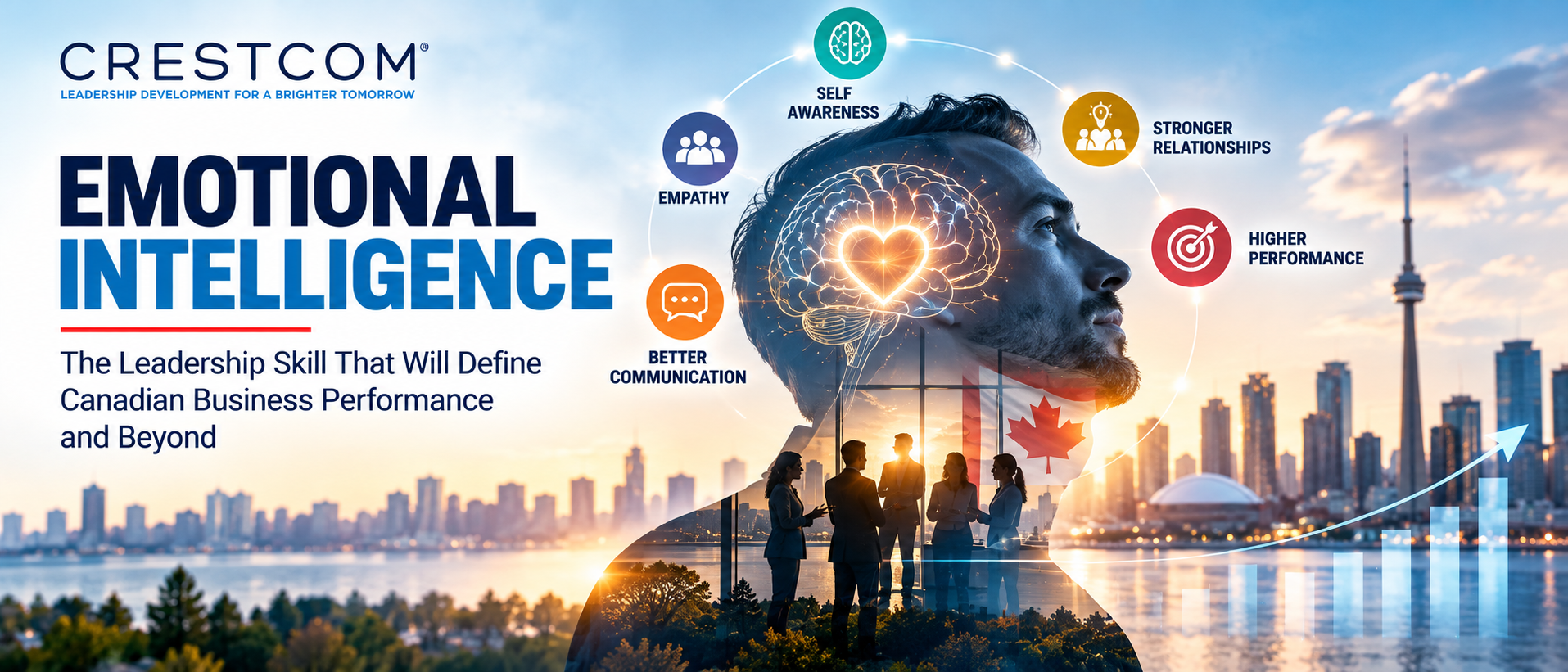
Here is the counterintuitive truth at the centre of 2026's leadership conversation: in the era of the most advanced artificial intelligence ever built, the single most valuable leadership capability is not a technical one. It is purely, irreducibly human.
Emotional intelligence leadership training in Canada has moved from a nice-to-have soft skill to a measurable performance driver.
TalentSmartEQ's research, based on data from over a million professionals, found that 90% of top performers score high in emotional intelligence — while just 20% of the lowest performers do. As AI absorbs more of the analytical and routine work inside organisations, the leadership capabilities that remain distinctly valuable are the ones AI cannot replicate: self-awareness, empathy, and the ability to navigate human emotion under pressure.
This article explains what emotional intelligence actually means for Canadian business leaders, what the data shows about its impact on performance and retention, and how EQ can be developed deliberately — not as a personality overhaul, but as a trainable leadership skill.
What Emotional Intelligence Actually Means for Canadian Business Leaders
Emotional intelligence, or EQ, is the capacity to recognise, understand, and manage your own emotions, while also recognising and appropriately influencing the emotions of others. It is distinct from IQ, and distinct from personality — it is a set of skills that determines how effectively a leader translates their technical competence and strategic thinking into results through other people.
This distinction matters more in 2026 than at any previous point in business history. At the 2026 World Economic Forum, a widely discussed Forbes feature on the evolution of leadership intelligence traced how leadership measurement has evolved: IQ built companies in an information economy, but EQ explained why the smartest person in the room was not always the most effective leader. The emerging conversation — extending EQ toward decency and genuine care for people and outcomes — reflects the same underlying shift: as AI commoditises raw intelligence and information processing, the leadership qualities that remain irreplaceable are the human ones.
For Canadian HR Directors and business leaders, the practical takeaway is straightforward: emotional intelligence is not a personality trait some leaders happen to have. It is a defined, learnable set of capabilities — and it is increasingly the capability that separates leaders who retain and develop strong teams from those who quietly lose them.
TALENTSMARTEQ RESEARCH
90% of top performers score high in emotional intelligence. Just 20% of bottom performers do. EQ alone explains 58% of a leader's job performance.
Source: TalentSmartEQ, workplace performance research
The Data: What High-EQ Leadership Does for Team Performance, Retention, and Profitability
The business case for emotional intelligence is no longer anecdotal. Independent research from multiple sources converges on the same conclusion: EQ is measurably tied to business outcomes.
Performance and Financial Impact
TalentSmartEQ's research found that EQ, tested alongside 33 other workplace skills, is the strongest single predictor of job performance — explaining 58% of the variance in success across all types of roles. High-EQ professionals were also found to earn substantially more on average than their low-EQ peers, with each incremental gain in emotional intelligence associated with a measurable increase in annual earnings.
Retention: The EQ-Turnover Link
The connection between manager EQ and employee retention is one of the most consistent findings in workplace research. Employees consistently cite their relationship with their direct manager — not compensation alone — as a primary driver of whether they stay or leave. A leader who cannot read team stress, regulate their own reactions under pressure, or communicate change with empathy creates the exact conditions that drive voluntary turnover, regardless of how technically capable that leader is.
The AI-Era Business Case
TalentSmartEQ's 2026 State of EQ Report, drawing on data from nearly 700 leadership, HR, and L&D professionals alongside EQ data from more than 23,000 individuals, found that the human skills required to make technology genuinely effective are now the strongest predictor of organisational performance in an AI-driven economy. The report also found that organisational change is accelerating — 54% of organisations now report frequent or constant change, up from 45% the year before — yet only 41% feel well-prepared to handle that disruption. EQ is precisely the capability that determines whether leaders navigate that gap successfully or are overwhelmed by it.
This aligns directly with the World Economic Forum's Future of Jobs Report 2025, which found that as AI and big data skills grow fastest in demand, human skills — including resilience, flexibility, agility, and leadership, all underpinned by emotional intelligence — remain equally critical, ranking among the fastest-growing core skills organisations will need through 2030.
WORLD ECONOMIC FORUM — FUTURE OF JOBS REPORT 2025
As AI and big data skills grow fastest in demand, resilience, flexibility, agility, and leadership — all underpinned by emotional intelligence — rank among the fastest-growing core skills for 2030.
Source: World Economic Forum, Future of Jobs Report 2025
The 5 Dimensions of Emotional Intelligence — and Why All Five Matter
Emotional intelligence is not a single, monolithic trait — it is a framework of five interconnected dimensions, first popularised by psychologist Daniel Goleman and grounded in decades of subsequent research. Leaders are rarely uniformly strong or weak across all five; most have a specific profile of strengths and gaps, which is precisely why objective assessment matters more than self-perception.
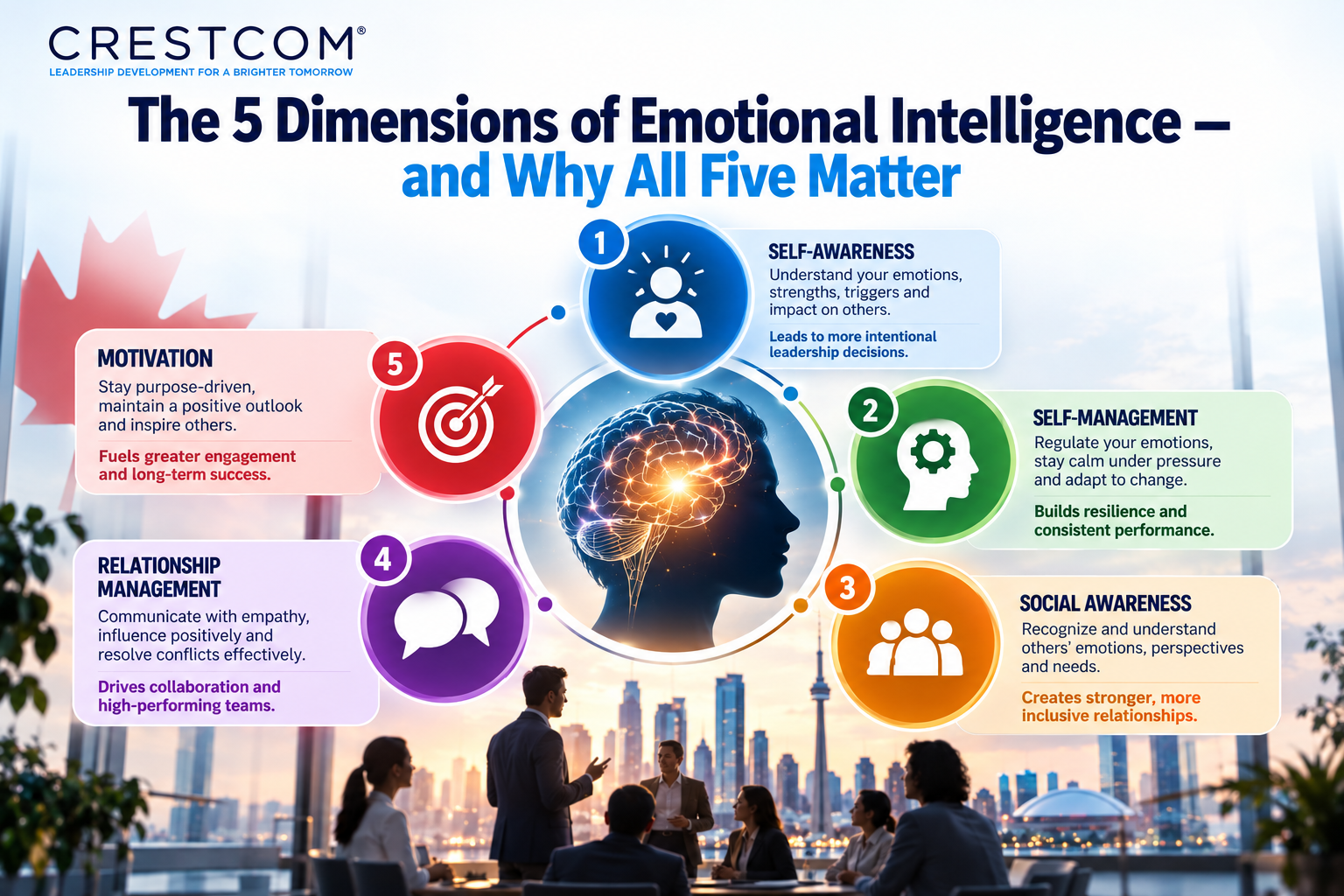
Notice that none of these five dimensions is exotic or abstract. Each is observable in daily leadership behaviour — how a manager responds to a missed deadline, how they open a difficult conversation, whether they notice when a team member is struggling before it becomes a resignation letter. This observability is exactly what makes EQ trainable: because the behaviours are visible and specific, they can be assessed, targeted, and developed with the same rigour applied to any other leadership competency.
The EQ Deficit in Canadian Management — and How It Is Showing Up in Your Business
Canadian workplaces are navigating a uniquely pressurised moment: post-pandemic cultural recalibration, accelerating AI adoption, multigenerational workforce tensions, and the ongoing complexity of hybrid team management. Against this backdrop,Conference Board of Canada research, conducted with the Future Skills Centre, found that when Canadians are asked to identify the most important skills for career success, they overwhelmingly point to social and emotional skills — communication, leadership, resilience, and interpersonal skills — ahead of narrowly technical capabilities. Yet the same research consistently finds these are also among the skills employers report as most lacking in their current workforce.
This gap shows up in specific, recognisable patterns inside Canadian organisations: managers who default to defensiveness rather than curiosity when receiving pushback; leaders who deliver difficult news abruptly, without reading the emotional impact on the room; teams where conflict festers unaddressed because the manager avoids the discomfort of naming it directly; and high performers who quietly disengage and eventually leave, citing 'culture' or 'fit' — language that frequently masks a manager relationship that lacked empathy or self-awareness.
These patterns compound over time. Crestcom Canada's analysis ofthe hidden cost of undertrained middle managers explores exactly this dynamic: managers promoted for technical competence, without deliberate development of the interpersonal and emotional capabilities the role actually demands, quietly become one of the largest hidden costs on a Canadian organisation's balance sheet.
Ask yourself honestly: when a member of your leadership team last received difficult feedback, did their response build trust with the room, or quietly erode it? Most HR Directors can answer that question immediately — and that instinctive answer is usually a more reliable EQ indicator than any self-assessment survey.
How to Develop Emotional Intelligence at the Management Level
The most important reframe for any organisation building an EQ development strategy is this: emotional intelligence is not a personality change. It is a skill — and skills are built through assessment, structured practice, and repetition, in exactly the same way any other leadership capability is developed.
Start With an Objective Baseline, Not Self-Perception
Most leaders significantly overestimate their own emotional intelligence, particularly in the dimensions of self-awareness and empathy — precisely the dimensions hardest to judge from the inside. TheCrestcom 360 Evaluation surfaces the emotional intelligence gaps that leaders are often genuinely blind to, replacing self-perception with structured, multi-rater feedback from the people who experience that leader's EQ daily — their team, peers, and manager. This creates both the development imperative and the baseline metrics needed to demonstrate measurable ROI once development is complete. Crestcom's guide tousing assessment and 360° feedback in leadership development explains how to interpret these results and translate them into a targeted EQ development plan for each leader.
Build EQ Through Structured, Sustained Practice — Not a Single Workshop
Because emotional intelligence is a skill rather than a switch, it does not change after a single seminar. It develops through repeated practice, feedback, and accountability — the model at the centre of theCrestcom LEADER program, which develops all five pillars of emotional intelligence through structured monthly sessions, peer accountability, and real-world application challenges over a full 12 months. This is not soft-skills training in the traditional sense — it is behavioural change built on structured repetition and measurement, following the same principle explored in Crestcom's broader article oncontinuous leadership development beyond episodic training.
Embed EQ Into How Leadership Is Defined, Not as an Add-On
EQ development is most effective when it is built into the organisation's core leadership competency framework, rather than treated as a supplementary workshop bolted onto existing management training. Crestcom'sapproach to leadership development embeds emotional intelligence directly into how leadership capability is defined and assessed — and organisations building or refreshing their own competency frameworks can find a practical starting point in Crestcom's guide todefining leadership principles and competency models.
Individual development plans matter here too — EQ gaps look different for a newly promoted manager than for a 15-year veteran director, and a one-size-fits-all programme will underserve both. Personalising the development pathway to each leader's specific EQ profile, rather than applying generic training, is what separates programmes that produce lasting behavioural change from those that produce a certificate and little else.
FAQs: Emotional Intelligence Leadership Training in Canada
Can emotional intelligence be developed, or is it a fixed personality trait?
Emotional intelligence is a skill, not a fixed personality trait — this is one of the most well-established findings in EQ research. Unlike IQ, which remains relatively stable across a person's life, and unlike core personality traits, the five dimensions of emotional intelligence — self-awareness, self-regulation, motivation, empathy, and social skills — can be measurably developed through structured feedback, deliberate practice, and sustained coaching. This is precisely why organisations invest in EQ development programmes rather than treating emotional intelligence as something leaders either have or lack permanently.
Why is emotional intelligence more important now than in previous decades?
As artificial intelligence takes on more of the analytical, administrative, and routine cognitive work inside organisations, the leadership capabilities that remain distinctly valuable are the ones AI cannot replicate — reading a room, building genuine trust, navigating conflict with empathy, and inspiring people through uncertainty. Research from the World Economic Forum and TalentSmartEQ both point to the same conclusion: as technical work becomes increasingly automated, human-centred leadership skills become the primary differentiator between organisations that thrive during disruption and those that don't.
What is the link between EQ and employee retention in Canadian workplaces?
Employee retention is heavily influenced by the quality of an employee's relationship with their direct manager, and that relationship quality is largely a function of the manager's emotional intelligence — their ability to communicate with empathy, manage conflict constructively, and notice disengagement before it becomes a resignation. Canadian organisations investing in EQ-focused management training typically see this reflected in stronger engagement scores and lower voluntary turnover within teams led by high-EQ managers, compared to teams led by managers with strong technical skills but underdeveloped interpersonal capability.
How do you measure emotional intelligence in a leadership team?
The most reliable measurement approach combines structured, validated EQ assessment tools with multi-rater 360-degree feedback — since self-assessment alone is notoriously unreliable, as most leaders overestimate their own self-awareness and empathy. Effective measurement establishes a baseline across all five EQ dimensions for each leader, identifies specific behavioural gaps rather than a single overall score, and is repeated periodically to track development progress and demonstrate return on investment from EQ-focused training initiatives.
What leadership development programmes focus on building emotional intelligence?
Effective EQ-focused leadership development combines objective assessment with sustained, structured practice rather than one-off workshops. Crestcom Canada's approach begins with the Crestcom 360 Evaluation to establish an objective EQ baseline for each leader, followed by the 12-month Crestcom LEADER programme, which develops all five pillars of emotional intelligence — self-awareness, self-regulation, motivation, empathy, and social skills — through structured monthly sessions, peer accountability, and real-world application challenges designed to produce lasting behavioural change rather than temporary awareness.
References
All external sources below are linked inline within the article body at the point of citation. Full source details are provided here for reference.
1. TalentSmartEQ. 'Emotional Intelligence at Workplace to Improve Performance.' TalentSmartEQ. talentsmarteq.com/emotional-intelligence-at-workplace-to-improve-performance
2. TalentSmartEQ. '2026 State of EQ Report: Human Skills Drive Performance in AI Economy.' Business Wire, February 2026. businesswire.com/news/home/20260216501159/en
3. Forbes (Shelley Zalis). 'The Future of Leadership: From IQ and EQ to DQ and LQ.' Forbes, February 2026. forbes.com/sites/shelleyzalis
4. World Economic Forum. 'Future of Jobs Report 2025.' World Economic Forum, January 2025. weforum.org/publications/the-future-of-jobs-report-2025
5. Conference Board of Canada / Future Skills Centre. Social and Emotional Skills research. conferenceboard.ca/future-skills-centre/research
6. HRPA (HR Professionals Association of Canada). Canadian management emotional literacy research, 2026. hrpa.ca
Interested in a free Leadership Skills Workshop with your team?
- Address instantly fixable issues that impact customer perceptions and employee morale.
- Learn and practice a habit that will raise employee performance.
- Set actions with specific and measurable steps that they'll gladly be accountable to achieve.