Why Employee Recognition Is Now a Core Leadership Skill — Not Just an HR program
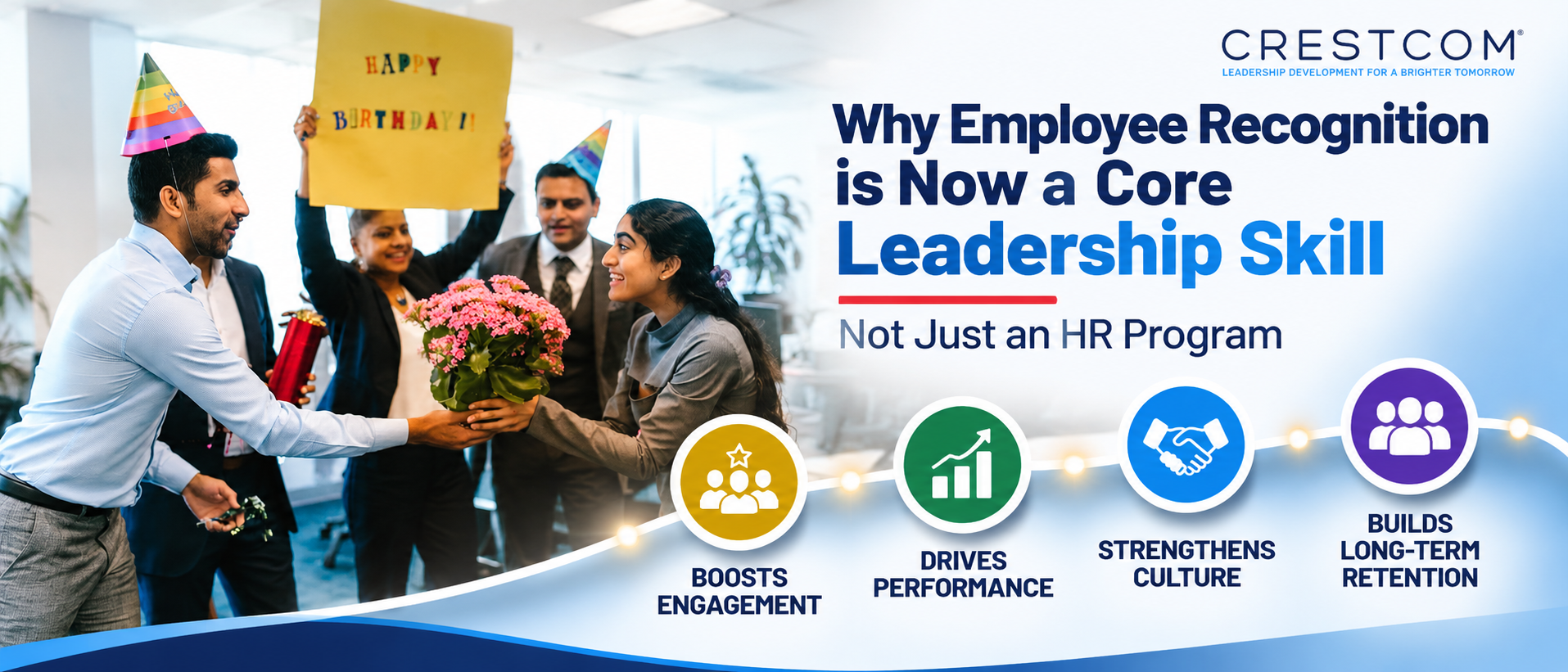
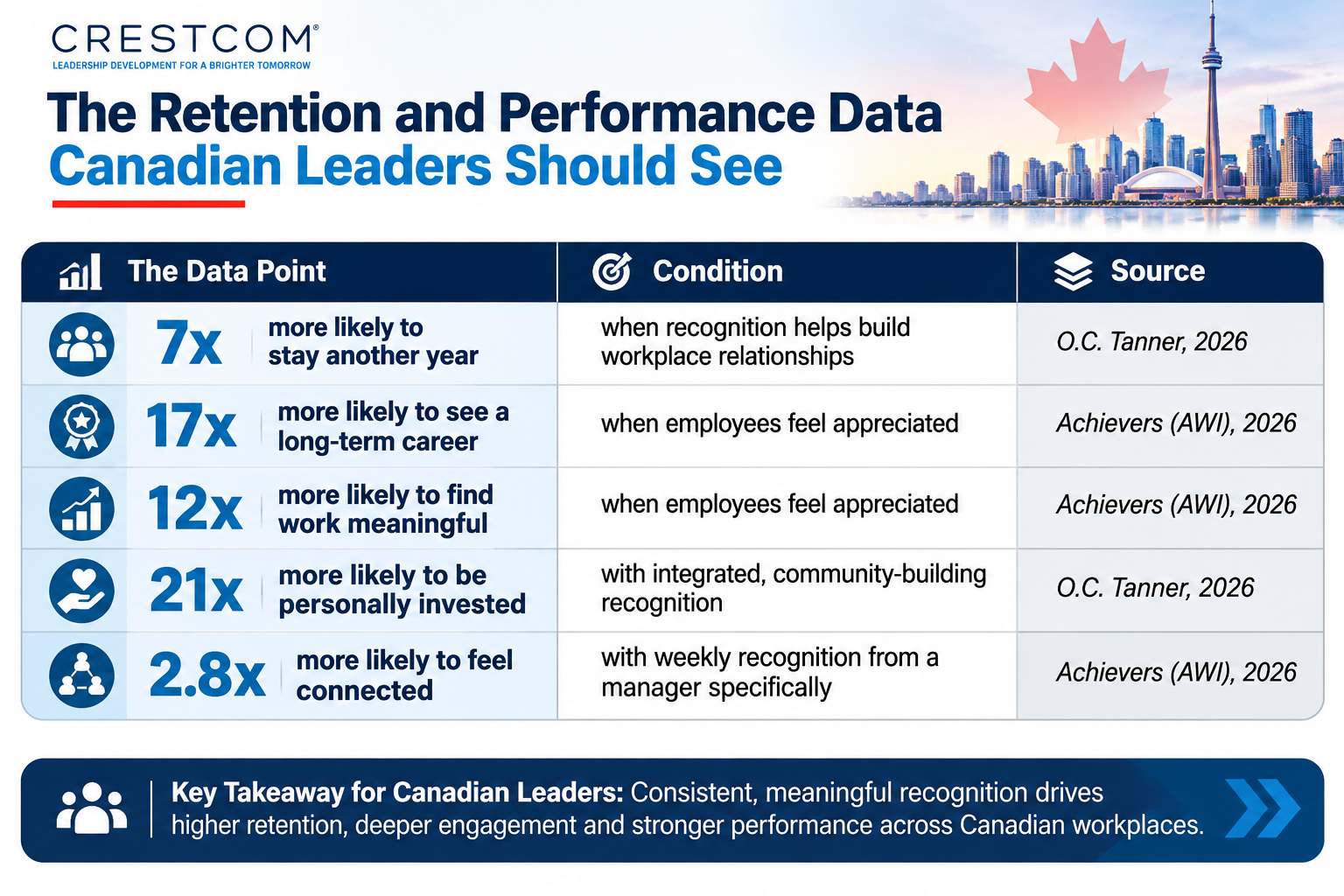
Here is a statistic most leaders haven't seen: employees are 7x more likely to stay another year. That finding comes from O.C. Tanner's 2026 State of Employee Recognition Report, a global study of more than 4,200 employees across 10 countries.
A second figure makes the case even more starkly. According to Achievers' 2026 Engagement and Retention Report, employees who feel appreciated are 17x more likely to see a long-term career. Leadership skills and employee recognition in Canada are converging around a single, measurable idea: recognition is no longer a discretionary HR perk. It is a core leadership behaviour with a direct, quantifiable line to retention.
This article explains why recognition has moved from HR program to leadership skill, what the retention and performance data actually shows, what manager-led recognition looks like in daily practice, and how Canadian organizations can build this capability deliberately into their leadership development strategy.
Why Recognition Moved From HR program to Leadership Skill
For years, employee recognition was treated as an HR-owned initiative — a points platform, an annual awards ceremony, a service-anniversary gift. The framing has shifted decisively in 2026. Forbes HR Council's February 2026 feature reframed recognition explicitly as "a consistent leadership practice" rather than an HR initiative — a distinction that matters enormously for how organizations invest in building it.
The distinction is not semantic. An HR program is something the organization installs — a platform, a policy, a budget line.
A leadership skill is something a manager practises daily, in the specific moments that shape how an employee experiences their work: after a difficult project, in a one-on-one, in the way a manager responds when someone goes beyond what was asked. Recognition delivered through a platform without a manager behind it consistently underperforms recognition delivered by an engaged, attentive leader — because employees are recognising the person giving it, not just the message.
Workhuman's 2026 Workplace Trends research reinforces this shift, framing recognition data increasingly as a culture and trust signal rather than a satisfaction metric — meaning organizations are now using recognition patterns to diagnose where trust in leadership is strong or eroding, not simply to track morale.
O.C. TANNER, 2026 STATE OF EMPLOYEE RECOGNITION REPORT
Employees are 7x more likely to stay another year when recognition helps build workplace relationships.
Source: O.C. Tanner Institute, global study of 4,200+ employees across 10 countries
The Retention and Performance Data Canadian Leaders Should See
The business case for recognition as a leadership skill is no longer built on sentiment — it is built on some of the most consistent, high-magnitude data points in workplace research today.
The Retention Multipliers
The table below summarises the key statistics driving this shift, each attributed to its source:
Why the Manager Specifically Matters
This is the clearest possible evidence that recognition delivered by HR systems alone, without manager engagement, leaves the majority of its retention value on the table.
These are not soft, feel-good numbers — they are performance multipliers directly tied to how consistently and authentically recognition is embedded into daily leadership behaviour.
ACHIEVERS WORKFORCE INSTITUTE, 2026
Employees who feel appreciated are 17x more likely to see a long-term career at their company, and 12x more likely to find their work meaningful.
Source: Achievers Workforce Institute, 2026 Engagement and Retention Report
What Manager-Led Recognition Actually Looks Like
If recognition is a leadership skill rather than a platform, what does it actually look like in daily practice? Four behaviours consistently distinguish manager-led recognition that produces these outcomes from recognition that doesn't move the needle.
It Is Specific, Not Generic
"Great job" delivered in passing carries little weight. Effective recognition names the specific action, connects it to its impact, and is delivered close to when the work happened — not batched into a quarterly review.
It Is Frequent, Not Occasional
The data is unambiguous that weekly, not annual, recognition drives the strongest retention and connection outcomes. This means recognition needs to become a habitual part of a manager's weekly rhythm — a specific behaviour built into one-on-ones and team check-ins — rather than an occasional gesture reserved for major wins.
It Builds Relationships, Not Just Transactions
[1]. A points-based reward with no personal context behind it produces a fraction of the retention value of recognition delivered through a genuine, relationship-aware conversation.
It Comes From the Manager, Not Just the System
As the data above shows, manager-delivered recognition produces dramatically stronger connection outcomes than system-generated recognition alone. This is the crux of why recognition belongs in leadership development rather than HR administration: the skill of delivering recognition well — specifically, frequently, and authentically — is a coaching and communication capability that has to be built and practised, not simply enabled through software.
Building Recognition Capability Through Leadership Development
For Canadian HR Directors under pressure to justify retention spend with hard data — particularly amid the RTO transitions and talent shortages many organizations are navigating in 2026, as explored in Crestcom Canada's guide to return-to-office leadership in Canada — recognition offers one of the most immediately measurable, low-cost retention levers available. Unlike compensation adjustments or major benefits redesigns, building manager recognition capability requires no new budget line, only deliberate skill development.
This is precisely where Crestcom's peer accountability model adds value. Rather than installing a recognition program, Crestcom builds recognition and feedback skills directly into the leadership curriculum — treating recognition as a manager capability to develop through structured practice, not a system to roll out. Crestcom's approach to continuous leadership development beyond episodic training explains why building a habit like weekly, specific recognition requires sustained practice and peer accountability over months, not a single training session on "how to give feedback."
Recognition capability also connects directly to how leadership performance is assessed. Crestcom's guide to using assessment and 360° feedback in leadership development outlines how manager behaviours like recognition frequency and quality can be surfaced through structured, multi-rater feedback — turning an often-invisible leadership gap into a measurable, developable skill with a clear before-and-after baseline.
The retention math is compelling on its own. Crestcom Canada's earlier analysis of the hidden cost of undertrained middle managers found that a large share of Canadian voluntary turnover traces back to manager behaviour rather than compensation or role fit — and recognition, backed by 7x and 17x retention multipliers, is one of the most direct, trainable levers available for closing that gap.
Frequently Asked Questions: Leadership Skills and Employee Recognition in Canada
Why is employee recognition considered a leadership skill in 2026?
Recognition has been reframed from an HR-owned program to a manager-owned leadership behaviour because the data increasingly shows that manager-delivered recognition produces dramatically stronger outcomes than system-generated recognition alone. Forbes HR Council's February 2026 analysis explicitly framed recognition as "a consistent leadership practice" — meaning it belongs in leadership development and coaching skill-building, not solely in HR platform administration.
How much does recognition actually affect employee retention?
These are among the largest multiplier effects found in workplace research, and both are specifically tied to recognition quality and consistency, not simply its presence.
What's the difference between HR-driven and manager-led recognition?
HR-driven recognition is typically system-based — points platforms, service awards, company-wide announcements — administered centrally and applied uniformly. Manager-led recognition is delivered directly by an employee's own manager, specific to their individual contribution, and embedded into regular one-on-one conversations. The data shows manager-led recognition produces substantially stronger connection and retention outcomes: weekly manager recognition makes employees 2.8x more likely to feel connected to their organization, while employees who don't receive regular manager recognition are more than twice as likely to leave in search of a better manager.
How can managers build recognition into daily leadership habits?
The most effective approach treats recognition as a specific, practicable skill rather than a personality trait some managers naturally have. This means building a weekly cadence for recognising specific contributions, connecting the recognition to its actual impact rather than offering generic praise, delivering it close to when the work happened rather than batching it into formal reviews, and using structured feedback tools to build self-awareness of how frequently — and how well — a manager is currently recognising their team. Leadership development programs that build coaching and feedback skills through sustained, structured practice are consistently more effective at embedding this habit than a single workshop on the topic.
References
Numbered citations below correspond to the bracketed reference markers [1]–[2] used throughout the article. All sources are also linked inline at the point of citation.
1. O.C. Tanner Institute. "The 2026 State of Employee Recognition: The Relationship Engine Behind High Performance." Global study of 4,200+ employees across 10 countries, O.C. Tanner, 2026.
2. Achievers Workforce Institute. "2026 Engagement and Retention Report." Global survey of employees and HR professionals across eight countries, Achievers, 2026.
3. Forbes Human Resources Council. "Recognition as a Leadership Practice." Forbes, February 2026.
4. Workhuman. "2026 Workplace Trends." Workhuman, 2026.
Interested in a free Leadership Skills Workshop with your team?
- Address instantly fixable issues that impact customer perceptions and employee morale.
- Learn and practice a habit that will raise employee performance.
- Set actions with specific and measurable steps that they'll gladly be accountable to achieve.