Why Leadership Succession Planning Must Be a Strategic Priority for Canadian Businesses in 2027
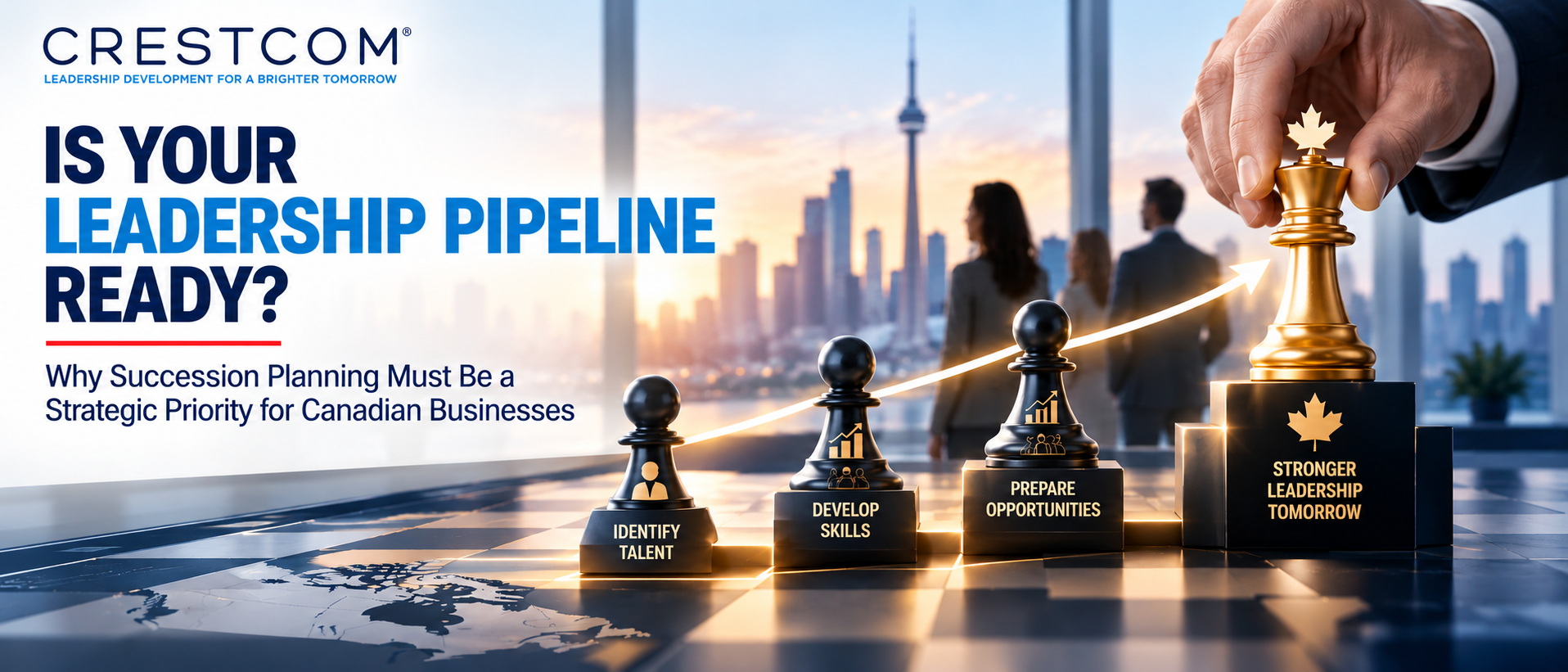
If your most critical leader resigned tomorrow, how confident are you that someone internally is ready to step in? For most organisations, the honest answer is not reassuring.Gallup research has found that only 5% of organisations have a strong bench of leaders ready to fill succession roles at any given time — meaning 95% of businesses are one unplanned departure away from a genuine leadership crisis.
Succession planning Canada leadership development has moved from a quiet HR administrative task to a board-level strategic priority in 2026. Two forces are colliding: a historic wave of retirements as Baby Boomer leaders exit the workforce, and AI-driven restructuring that is flattening organisations and eliminating many of the middle management roles that traditionally served as the training ground for senior leaders.
This article explains why the succession planning crisis is accelerating, what it is actually costing unprepared Canadian businesses, and how structured leadership development programmes can build a resilient pipeline — not just at the CEO level, but at every level where leadership continuity matters.
Why the Succession Planning Crisis Is Accelerating in 2027
Two structural shifts are compounding to create what one industry analysis called a "hollow pipeline crisis." The first is demographic. Statistics Canada and RBC Economics research indicates that roughly 2.7 million Canadians currently aged 60 to 64 are approaching retirement, with the final and largest wave of Baby Boomer retirements set to unfold through 2030 as the youngest Boomers turn 65. Labour force participation is projected to keep declining through the end of the decade as a direct result.
The second shift is structural.Deloitte's Global Human Capital Trends research has identified the erosion of traditional leadership pipelines as one of the most consequential risks organisations face — driven in part by AI-enabled restructuring that is flattening middle management layers. Deloitte's research found that 73% of organisations recognise the importance of reinventing the role of the manager, yet just 7% report making great progress on doing so. The middle management roles that once served as the proving ground for future executives are shrinking at precisely the moment the demographic pipeline needs them most.
For Canadian businesses, these two forces do not operate independently — they compound. Fewer structured pathways into leadership are opening at exactly the moment more leadership vacancies are about to appear.
GALLUP RESEARCH
Only 5% of organisations have a strong bench of leaders ready to fill succession roles at any given time.
Source: Gallup, 'Building Your Bench Strength'.
The Hidden Cost of Unplanned Leadership Transitions for Canadian Businesses
The financial consequences of poor succession planning are larger, and more immediate, than most executives assume.
Market Value and Stock Impact
Research analysing S&P 1500 firms has found that poorly managed leadership transitions have erased close to one trillion dollars in aggregate market value, with unplanned CEO departures triggering an average 20% stock price decline. While most Canadian SMEs are not publicly traded, the underlying dynamic — sudden loss of leadership confidence translating directly into lost value — applies just as forcefully to private businesses facing client, lender, and employee confidence.
The One-in-Five Canadian Visibility Gap
HRPA (HR Professionals Association of Canada) data indicates that fewer than one in five Canadian organisations report strong visibility into their leadership pipeline — meaning the large majority of Canadian HR Directors cannot currently answer, with confidence, who would step into a critical leadership role if it became vacant tomorrow. For Canadian SMEs, where a single senior leader often carries disproportionate institutional knowledge and client relationships, this visibility gap represents concentrated operational risk.
Failed Transitions Compound the Cost
Even when a successor is named, the transition frequently fails without structured preparation. Roughly half of leadership transitions fail within 18 months when proper development and planning have not taken place — meaning the organisation absorbs the cost of the original vacancy and then repeats the disruption a second time. This is precisely why Crestcom Canada's analysis of the hidden cost of undertrained middle managers found that Canadian businesses consistently underestimate the compounding cost of promoting leaders without the structured development to succeed in the role — succession planning without development readiness simply moves the same risk one level up the organisation.
What Effective Succession Planning Looks Like Beyond Spreadsheets and 'High-Potential' Lists
Many Canadian organisations believe they have a succession plan because they maintain a spreadsheet of high-potential employees or a nine-box grid reviewed once a year. This is succession documentation — not succession readiness.
Gallup's research on succession planning methodology found that in a survey of large-company CHROs, only a small minority strongly agreed their organisation is excellent at identifying and selecting the right candidates for leadership roles, and — despite nearly two-thirds of companies using the traditional 9-box grid — fewer than one in ten strongly agreed it is an effective approach for their organisation. The tool itself is not the problem. The problem is treating identification as if it were development.
Effective succession planning requires three elements that a spreadsheet cannot provide: a clearly defined competency profile for each critical role, so that candidate assessment is objective rather than a subjective gut call; an active development plan for each identified successor, built around real skill gaps rather than a vague sense of 'potential'; and a readiness timeline that is reviewed and updated regularly — not filed away until the vacancy actually occurs.
Crestcom Canada's guide to defining leadership principles and competency models provides a practical framework for building the competency profiles that make succession candidate assessment objective and defensible — the essential foundation that most 9-box exercises are missing.
Building a Leadership Pipeline at Every Level — Not Just the C-Suite
A common misconception is that succession planning is primarily about identifying the next CEO. In reality, the roles most likely to create sudden operational disruption are often one or two levels below the C-suite — the regional director, the VP of Operations, the plant manager with 20 years of institutional knowledge. A resilient pipeline addresses leadership continuity at every level where a vacancy would meaningfully disrupt the business.
The table below outlines how pipeline development priorities shift across leadership levels:
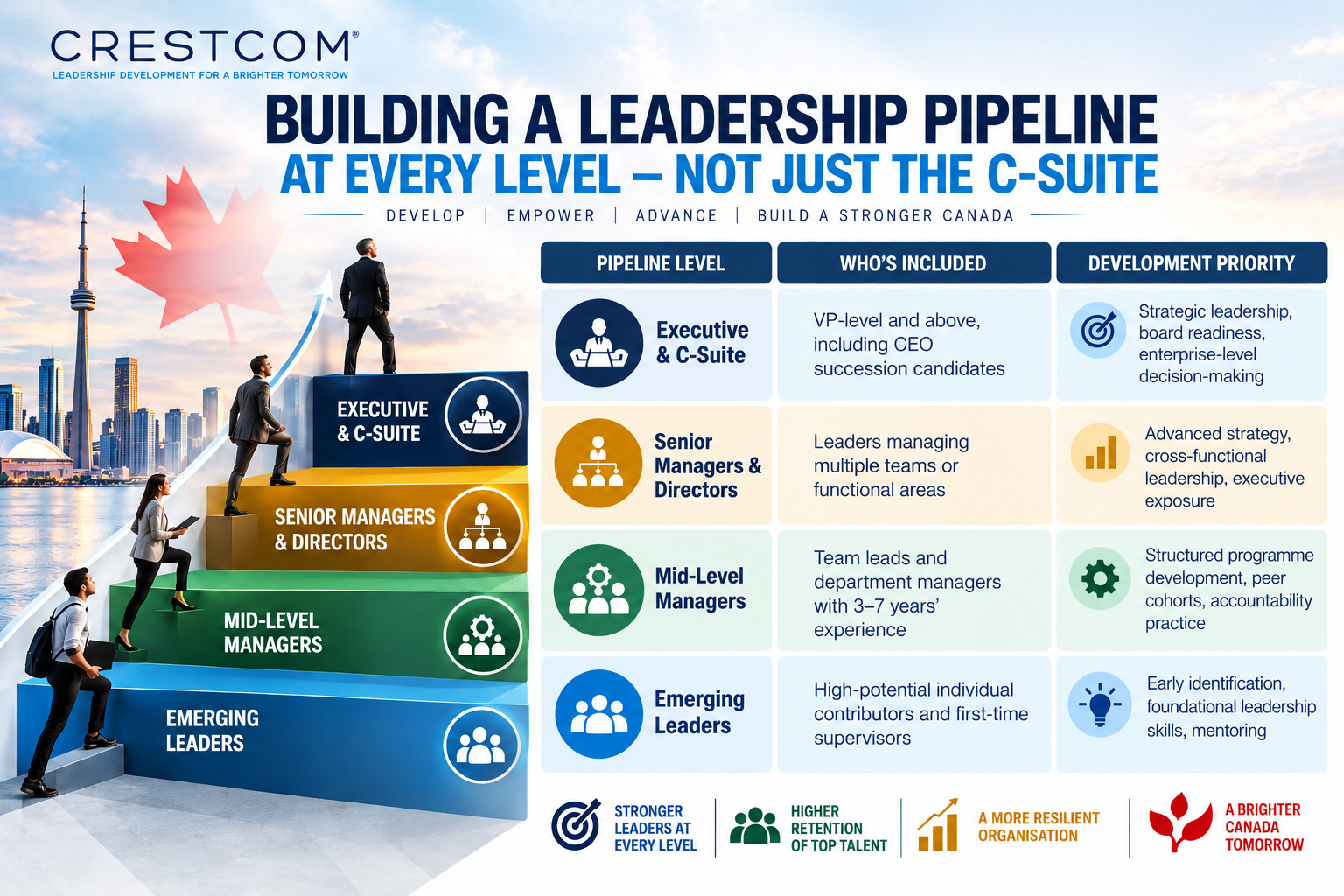
Building this kind of multi-level pipeline requires designing individual development pathways rather than a single generic training programme. Crestcom Canada's article on designing personal leadership development pathways explains how organisations can align development investment to each leader's specific competency gaps and career trajectory — the same logic that makes a succession pipeline credible rather than aspirational.
How to Integrate Development Programmes Into Your Succession Strategy
Identifying successors solves half the problem. The other half — and the half most Canadian organisations neglect — is ensuring those successors are genuinely ready when the moment arrives. This requires embedding structured development directly into the succession planning process, rather than treating the two as separate HR functions.
Start With an Objective Readiness Assessment
Before development can be targeted, organisations need an objective picture of each candidate's current capability against the competencies the target role demands. The Crestcom 360 Evaluation provides exactly this — structured, multi-rater feedback that replaces subjective 'gut feel' potential ratings with an evidence-based readiness profile for each succession candidate.
Build Mid-Level Readiness Through Structured, Sustained Development
For managers and directors identified as succession candidates, the Crestcom LEADER+ programme provides 12 months of structured, accountable leadership development — building the strategic thinking, change leadership, and people management capabilities that separate a technically strong performer from a leader genuinely ready to take on broader responsibility. This kind of sustained, cohort-based development consistently outperforms one-off training events, a principle explored in depth in Crestcom's article on continuous leadership development beyond episodic training.
Prepare Senior Candidates for Executive and Strategic Roles
For candidates on track for senior executive or top-level roles, the Crestcom Strategy Programme builds the enterprise-level strategic thinking, board readiness, and executive decision-making capability that distinguishes a strong functional leader from a leader ready to run the business. For CEO succession specifically, Crestcom Canada's CEO Path to Growth programme provides a dedicated development track for candidates identified for the organisation's top role.
The organisations that consistently avoid succession crises are not the ones with the most detailed spreadsheet. They are the ones that treat succession readiness as an ongoing development investment — assessed, developed, and reviewed continuously, rather than assembled hastily after a vacancy has already occurred.
FAQs: Succession Planning for Canadian Businesses
What is succession planning and why does it matter for Canadian SMEs?
Succession planning is the structured process of identifying critical leadership roles, developing internal candidates to fill them, and maintaining a ready pipeline so that leadership transitions — whether planned or sudden — do not disrupt business continuity. For Canadian SMEs, succession planning matters disproportionately because a single senior leader often holds concentrated institutional knowledge, client relationships, and operational expertise that cannot easily be replaced externally. Without a plan, the departure of one key leader can create a level of disruption that a larger organisation, with more distributed leadership capacity, would be better positioned to absorb.
How many leadership levels should a succession plan cover?
Effective succession planning covers every leadership level where an unplanned vacancy would meaningfully disrupt the business — typically this means emerging leaders and first-time supervisors, mid-level managers and directors, senior managers, and executive or C-suite roles. Best practice guidance generally recommends focusing formal succession planning on roughly the top tier of positions where vacancy without a ready successor creates genuine organisational risk, rather than attempting to build formal succession plans for every role in the organisation, which can dilute focus and resources.
How do you identify high-potential leaders for succession?
Effective identification combines objective performance data with structured leadership assessment — such as 360-degree feedback — rather than relying solely on manager nomination or subjective impressions of 'potential.' The most reliable approach assesses candidates against clearly defined competency profiles for the target role, considers both current performance and demonstrated leadership behaviours, and reviews candidates against multiple perspectives rather than a single manager's opinion. Tools like structured 360 evaluations are specifically designed to reduce the bias inherent in informal, single-rater succession nominations.
What is the difference between succession planning and replacement planning?
Replacement planning is a reactive exercise focused narrowly on identifying who could technically step into a role if it became vacant tomorrow — often just a name on a document, without any accompanying development. Succession planning is a proactive, ongoing process that identifies future leadership needs, actively develops candidates against real competency gaps, and builds genuine readiness over months or years. The distinction matters enormously: replacement planning creates a false sense of security, while succession planning creates leaders who are actually prepared to succeed in the role, not just occupy it.
How can leadership development programmes support succession readiness?
Structured leadership development programmes are the mechanism that converts a list of identified successors into a genuinely ready pipeline. Programmes built on sustained, accountable development — rather than single training events — build the specific strategic, communication, and decision-making capabilities each succession candidate needs for their target role. When development is directly tied to the competency gaps identified through objective assessment, and sustained over 12 months or more, organisations see measurably higher rates of successful, low-disruption leadership transitions compared to those relying on informal, ad hoc preparation.
References
All external sources below are linked inline within the article body at the point of citation. Full source details are provided here for reference.
1. Gallup. 'Building Your Bench Strength.' Gallup Business Journal. gallup.com/workplace/236948/building-bench-strength-part.aspx
2. Gallup. 'Avoid Getting Boxed In by Conventional Succession Planning Methods.' Gallup, 2026. gallup.com/workplace/647864
3. Deloitte. '2026 Global Human Capital Trends: From Tensions to Tipping Points.' Deloitte Insights, 2026. deloitte.com/us/en/insights/topics/talent/human-capital-trends.html
4. Statistics Canada / RBC Economics. 'Canada Faces Peak Aging as Final Boomers Retire and Population Growth Slows.' RBC Thought Leadership, 2025–2026. rbc.com/en/thought-leadership/economics
5. HRPA (HR Professionals Association of Canada). Canadian succession planning and leadership pipeline visibility research, 2026. hrpa.ca
6. Chief Learning Officer. 'How to Cultivate Adaptable Leaders with Integrated Succession Planning.' February 2026. chieflearningofficer.com
Interested in a free Leadership Skills Workshop with your team?
- Address instantly fixable issues that impact customer perceptions and employee morale.
- Learn and practice a habit that will raise employee performance.
- Set actions with specific and measurable steps that they'll gladly be accountable to achieve.