Building Psychological Safety in Canadian Workplaces: The Leadership Skill That Changes Everything

Google once spent two years studying 180 of its own teams, examining 250 different attributes, to answer one question: what separates a high-performing team from an average one? It was not intelligence. It was not experience. It was not resources. The single strongest predictor of team effectiveness was psychological safety — the belief that a person will not be punished or humiliated for speaking up with ideas, questions, concerns, or mistakes.
For Canadian HR Directors and business leaders, this finding from Google'sProject Aristotle research has aged remarkably well. Psychological safety leadership in Canada has moved from an academic concept to a measurable business priority, and the organisations that treat it as core leadership development — rather than a culture initiative — are the ones seeing the retention, engagement, and performance gains to prove it.
This article explains what psychological safety actually means, the data Canadian executives should be paying attention to, and the specific leadership behaviours that build it — starting with how your managers show up every day.
What Psychological Safety Actually Means (and What It Does Not Mean)
Psychological safety, a term coined by Harvard Business School professor Amy Edmondson in 1999, describes a shared belief within a team that it is safe to take interpersonal risks — asking questions, admitting mistakes, offering dissenting opinions — without fear of embarrassment or retaliation. It is a team-level condition, not an individual personality trait, and it is created primarily through the behaviour of the team's leader.
It is important to be precise about what psychological safety is not. It is not the absence of conflict, disagreement, or accountability. It is not about being universally liked or avoiding hard conversations. In fact, psychologically safe teams tend to have more open disagreement and more direct feedback than unsafe ones — because people trust that raising a concern will be met with curiosity rather than punishment.
A psychologically safe team is not a comfortable team in the sense of being conflict-free. It is a team where the discomfort of speaking up is outweighed by the trust that doing so is safe and valued.
GOOGLE — PROJECT ARISTOTLE
Of the five dynamics that distinguished Google's highest-performing teams, psychological safety was found to be the most important.
Source: Google re:Work, Project Aristotle (2012–2014 research initiative).
The Business Case: What Gallup, HBR, and McKinsey Data Show Canadian Executives
For executives who need more than a compelling research story to justify investment, the data on psychological safety is unusually consistent across independent sources.
The Engagement Gap Is Larger Than Most Leaders Realise
Gallup's ongoing engagement research finds that fewer than three in ten employees feel that their opinions count at work — one of the twelve core drivers Gallup uses to measure workplace engagement. This single item is closely tied to whether employees feel safe contributing ideas, flagging problems, or challenging decisions. When that number is this low, it signals that most organisations — not just underperforming ones — have a structural psychological safety gap.
The Profitability and Retention Link
Gallup research shows that teams with high engagement — closely correlated with psychological safety — report 21% higher profitability than disengaged teams. Harvard Business Review's recent analysis of workplace trust and psychological safety data has found that employees on high-safety teams are substantially less likely to leave their roles voluntarily, reinforcing that safety is not a soft outcome — it is a direct lever on turnover cost. This mirrors what Crestcom Canada has explored in depth in The Hidden Cost of Undertrained Middle Managers: the quality of frontline leadership is one of the single largest levers on voluntary turnover in Canadian organisations.
The Leadership Gap McKinsey Identified
Perhaps the most actionable finding comes from McKinsey's research into the organisational drivers of psychological safety. McKinsey found that a positive team climate is the most important driver of psychological safety — and that only 43% of employees report their team currently has one. Critically, McKinsey's research shows that team leaders have the strongest influence over whether that climate exists, through consistent supportive and consultative behaviours. This places the responsibility — and the opportunity — squarely on manager development.
MCKINSEY RESEARCH
Only 43% of employees report their team has a positive climate — the most important driver of psychological safety. Team leaders have the strongest influence over whether it exists.
Source: McKinsey & Company, 'Psychological Safety and the Critical Role of Leadership Development'.
The 5 Leadership Behaviours That Build Psychological Safety on Your Team
Psychological safety is not an abstract cultural quality — it is built through specific, repeatable leadership behaviours. The table below outlines the five behaviours most consistently linked to safety-building leadership, and why each one matters:
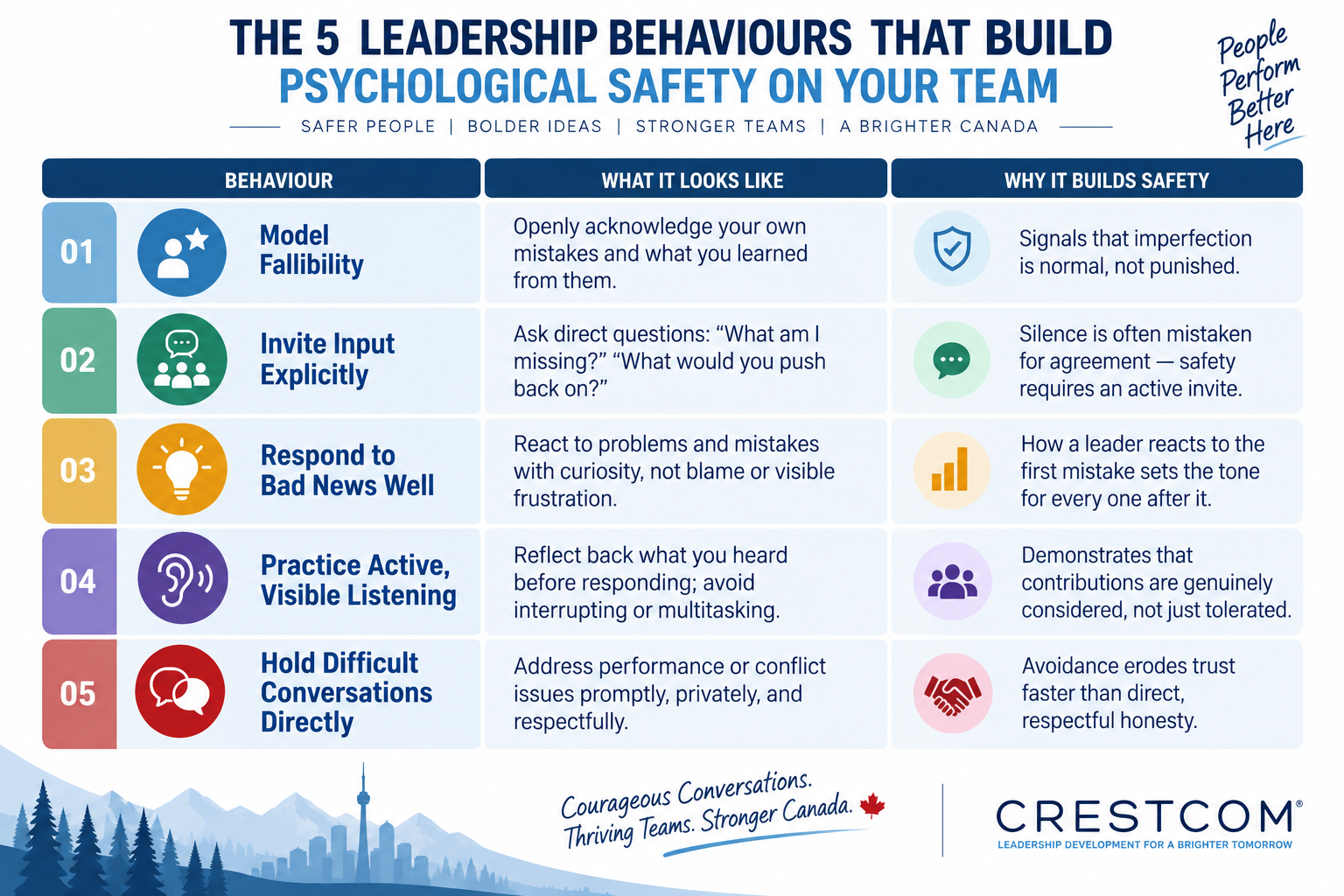
None of these behaviours require charisma or a particular personality type. They are learnable, observable, and — critically for HR Directors building a business case — trainable through structured leadership development. This is precisely why SHRM's State of the Workplace research found that for the second consecutive year, 46% of CHROs rank leadership and manager development as their top organisational priority, with psychological safety emerging as the most frequently cited development need within that priority. Building these behaviours into a formal capability framework — rather than treating them as personality traits — is the approach explored in Crestcom Canada's guide to defining leadership principles and competency models.
Why Psychological Safety Is Harder to Build in Hybrid and Remote Canadian Workplaces
Canadian organisations face a distinct version of this challenge. With a majority of Canadian workers reporting a preference for hybrid or remote work arrangements, according to Statistics Canada labour force data, many of the informal cues that once signalled safety — a reassuring nod in a meeting, a quiet check-in at someone's desk, the ability to read body language — are simply absent from much of the workday.
In distributed teams, psychological safety has to be built more deliberately, because it can no longer rely on incidental, in-person interaction. A manager who was naturally warm and approachable in an office setting may inadvertently come across as distant or transactional over video calls and asynchronous messaging — not because their intent has changed, but because the medium strips out many of the signals that previously conveyed safety.
This is compounded by a trust and communication gap that Canadian workplace research has consistently identified, particularly in sectors experiencing rapid growth, restructuring, or significant technological change. For Canadian HR Directors managing distributed or hybrid teams, building psychological safety is not optional cultural polish — it is a core leadership competency that determines whether hybrid work models succeed or quietly erode engagement over time. Crestcom Canada's guide to leading remotely and building leader capabilities for distributed and hybrid teams explores this challenge in greater depth, including the specific capabilities managers need to lead distributed teams effectively.
Ask yourself: on your distributed teams, how would a team member currently raise a concern about a decision they disagreed with? If the honest answer is "they probably wouldn't," that is the psychological safety gap made visible.
How to Embed Safety-Building Behaviours Through Structured Leadership Development
Knowing the five behaviours that build psychological safety is the easy part. Embedding them consistently, across every manager in an organisation, requires more than a single workshop or a values statement on the wall.
Start With an Objective Baseline
Most managers believe they already demonstrate safety-building behaviours more consistently than their teams actually experience them. This perception gap is exactly why objective, multi-rater feedback matters. The Crestcom 360 Evaluation gives leaders a clear, structured view of how their behaviour is actually perceived by the people who report to them — the essential starting point for any psychological safety improvement effort. Without this baseline, development efforts target the wrong behaviours or fail to demonstrate measurable progress. Crestcom's guide on using assessment and 360° feedback in leadership development explores this process in more detail, including how to interpret results and translate them into a targeted development plan.
Build the Behaviours Through Repeated, Structured Practice
Psychological safety behaviours — active listening, inviting dissent, responding to bad news with curiosity — are not learned by reading about them once. They are built through repetition, feedback, and accountability over time. This is the foundation of Crestcom's approach to leadership development: structured practice, peer learning, and consistent accountability that translate concepts into daily behaviour, rather than delivering a single motivational session and hoping the change sticks. Crestcom Canada's article on continuous leadership development beyond episodic training makes the broader case for why this sustained approach consistently outperforms one-time workshops for building durable leadership behaviours.
Sustain Development Over a Full Business Cycle
Because safety-building behaviours need to become habitual rather than performative, they are best developed over an extended period. The Crestcom LEADER programme provides 12 months of structured, accountable development — giving leaders the repeated practice, coaching, and peer reinforcement needed to embed new behaviours permanently, rather than temporarily, into how they lead their teams.
The organisations that succeed at building psychological safety are not the ones with the best mission statement about it. They are the ones that treat the underlying leadership behaviours as a trainable, measurable capability, embedded within a broader leadership development system — the kind outlined in Crestcom Canada's 10-element framework for building a leadership development system — and invest accordingly.
Frequently Asked Questions: Psychological Safety Leadership in Canada
What is psychological safety and why does it matter for team performance?
Psychological safety is a shared team belief that it is safe to take interpersonal risks — asking questions, raising concerns, admitting mistakes, or offering a dissenting view — without fear of embarrassment or punishment. It matters because Google's Project Aristotle research found it to be the single strongest predictor of team effectiveness among 180 teams studied, and subsequent research from Gallup and McKinsey has consistently linked it to higher engagement, lower turnover, and stronger business performance. Teams without psychological safety tend to withhold ideas, hide mistakes, and avoid raising problems early — all of which quietly erode performance over time.
How do leaders build psychological safety in hybrid or remote teams?
Leaders in hybrid and remote Canadian workplaces need to be more deliberate about signalling safety, since many of the informal in-person cues are absent. This means explicitly inviting input during virtual meetings rather than assuming silence means agreement, practising visible active listening on video calls, following up individually after meetings with quieter team members, and being especially consistent in how mistakes and bad news are received — since a delayed or curt response over chat can read as far more punitive than the same response delivered in person.
Is psychological safety the same as being nice or avoiding conflict?
No — this is one of the most common misconceptions. Psychological safety is not about comfort, agreeableness, or avoiding difficult conversations. In fact, psychologically safe teams tend to engage in more direct, open disagreement than unsafe ones, because team members trust that raising a hard truth will be met with curiosity rather than retaliation. A leader who avoids giving honest feedback to preserve short-term comfort is not building psychological safety — they may actually be undermining it, since team members learn that real issues are not discussed openly.
How long does it take to build psychological safety in a team?
Psychological safety is built incrementally through consistent leadership behaviour over time, not established through a single event or announcement. Teams typically begin to notice early shifts in openness within the first few months of consistent behaviour change from their leader, with meaningful, durable safety developing over six to twelve months of sustained practice. This is why structured development programmes that span a full year — rather than a single workshop — tend to produce more reliable, lasting results than short-term training interventions.
What is the ROI of psychological safety for Canadian businesses?
The return on investment shows up across several measurable areas: higher team engagement, which Gallup links to meaningfully higher profitability; lower voluntary turnover and the associated recruitment and onboarding costs; faster problem identification, since team members raise issues earlier rather than letting them escalate; and stronger innovation and idea generation, since psychologically safe teams surface more ideas and challenge assumptions more freely. For Canadian organisations calculating the business case, the combination of retention savings and engagement-driven productivity gains typically represents a substantial, defensible return relative to the cost of structured leadership development.
References
All external sources below are linked inline within the article body at the point of citation. Full source details are provided here for reference.
2. Gallup. 'Item 7: My Opinions Seem to Count.' Gallup Inc.
Interested in a free Leadership Skills Workshop with your team?
- Address instantly fixable issues that impact customer perceptions and employee morale.
- Learn and practice a habit that will raise employee performance.
- Set actions with specific and measurable steps that they'll gladly be accountable to achieve.